What was the biggest dinosaur?
Probably Argentinosaurus, a long-necked titanosaur from Argentina: about 30 to 35 m (98 to 115 ft) long and roughly 65 to 80 tonnes, by models from a few bones. Nobody can be sure. No complete skeleton of any of the largest kinds has ever been found, and its relative Patagotitan comes close. Our Argentinosaurus in the picture is 30.6 m (100 ft) long, as long as 18 people, each 1.70 m, laid end to end.
Biggest means three things. The heaviest was most likely a titanosaur from Patagonia, Argentinosaurus or Patagotitan. The longest is not settled. The tallest was probably Sauroposeidon, its head about 17 m (56 ft) up, by four neck bones.
- Argentinosaurus, about 30.6 m
- Brachiosaurus, about 24.4 m along the backbone (21.5 m straight, neck raised)
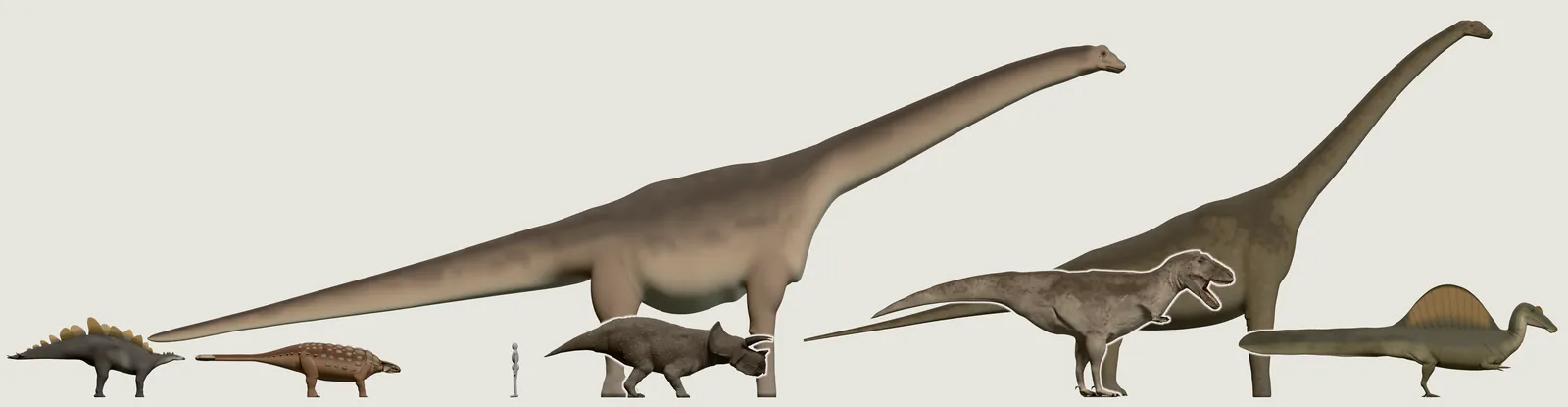
- Stegosaurus, about 5.6 m
- Ankylosaurus, about 6.4 m
- The person, 1.70 m
- Triceratops, about 6.9 m
- T. rex, about 11.4 m
- Spinosaurus, about 10 m, a young animal
- T. rex, about 11.4 m
- Spinosaurus, about 10 m, a young animal

- Stegosaurus, about 5.6 m
- Triceratops, about 6.9 m
- The person, 1.70 m
- Ankylosaurus, about 6.4 m
A guess
Which of our seven stands exactly as high at the hips as the person, 1.70 m?
Show the answerHide the answer
Our Ankylosaurus. Its hips are 1.70 m high, the person's own height, and it is 6.4 m long, almost four people laid end to end.
The wing for these animals is still being built, and the Leonardo da Vinci wing is open today.
The numbers
| Animal | Our model, length | The species or the skeleton | Weight | How sure |
|---|---|---|---|---|
| Argentinosaurus, Argentinosaurus huinculensis | about 30.6 m (100 ft), 32.1 m (105 ft) along the backbone | about 30 to 35 m (98 to 115 ft), rebuilt, never measured | roughly 65 to 80 t, a model | one partial skeleton, the body borrowed from relatives |
| Brachiosaurus, Brachiosaurus altithorax | about 24.4 m (80 ft) along the backbone, 21.5 m (71 ft) straight with the neck raised | about 22 to 25 m (72 to 82 ft), rebuilt | roughly 30 to 45 t, rebuilt | one partial skeleton, neck and head borrowed |
| T. rex, Tyrannosaurus rex | about 11.4 m (37 ft) | SUE's skeleton about 12 m (39 ft) | about 8 to 9 t | one of the largest and most complete skeletons, several models |
| Spinosaurus, Spinosaurus aegyptiacus | about 10 m (33 ft), a young animal | this animal about 10 to 11 m (33 to 36 ft), adults about 13 to 14 m (43 to 46 ft) | this animal about 3 to 4 t, adults about 7.4 t, by models | one young partial skeleton, the adult scaled up |
| Triceratops, Triceratops horridus | about 6.9 m (23 ft) | large skeletons 6.7 to 8 m (22 to 26 ft) | about 6.5 to 8.5 t, by two models | a mount of about ten animals |
| Ankylosaurus, Ankylosaurus magniventris | about 6.4 m (21 ft) | this skeleton 6.02 to 7.95 m (20 to 26 ft), by relatives' tails | about 4.8 t, by its leg bones | three partial skeletons, none complete |
| Stegosaurus, Stegosaurus stenops | about 5.6 m (18 ft) | Sophie's mount 5.6 m (18 ft), the paper 5.5 to 6 m | about 1.6 t, a model of her own skeleton | one almost complete animal |
| The person | 1.70 m (5 ft 7 in) | the museum's scale figure |
Three answers, and the biggest meat-eater
The heaviest
Most likely a titanosaur from Patagonia, Argentinosaurus or Patagotitan. Argentinosaurus is the best-supported candidate, roughly 65 to 80 tonnes by several models, all from a few bones. Patagotitan, known from at least six animals, was put at 69 tonnes in 2017 and corrected by its own team to about 57 in 2020. Which of the two was bigger is open: they share too few bones to compare. Dreadnoughtus, once put at 59 tonnes, now comes to about 22 to 30.
The longest
Nobody knows. The best-known titanosaurs come to about 30 to 37 m (98 to 121 ft) by their bones and casts. Supersaurus, a long-tailed cousin of Diplodocus, was put at 39 to 42 m (128 to 138 ft) in a conference talk of 2021, not yet in a journal.
The tallest
Probably Sauroposeidon, from Oklahoma, its head about 17 m (56 ft) up. That rests on four neck bones found in 1994, scaled up on the proportions of Brachiosaurus. The Natural History Museum in London notes it may sit nearer the titanosaurs. Weak, but nothing better is known. The tallest skeleton you can visit is Giraffatitan in Berlin, its skull about 13 m (43 ft) up.
The biggest meat-eater
Two answers. By length, Spinosaurus: a grown one was just under 14 m (46 ft) in the model of 2022, scaled up from a young skeleton and a loose adult snout. By weight, T. rex: the heaviest known, called Scotty, comes to about 8.9 tonnes, and a big adult was about 12 m (39 ft) long. Giganotosaurus is often named too, but its remains are fragments and its estimates run from about 6.5 to 14 tonnes.
Numbers you may have read
For each number: where it came from, and what the field makes of it now.
- 39.7 m (130 ft), and 40 m
- The mounted skeleton in the Museo Carmen Funes in Plaza Huincul, built in the 1990s from the few real bones as a guide. A laser scan of 2013 measured it at 39.7 m. That is a sculpture's length, 5 to 10 m more than any estimate from the bones, and 40 m is that figure rounded. The cast in Atlanta is of the same kind, over 123 feet (about 37.5 m) by its museum.
- 100 tonnes, and 83
- The 100 came from guesses of the 1990s and an early volume model of 80 to 100. The 83 is the scanned mount of 2013 wrapped in a digital skin, so it belongs to the sculpture. Today's models give roughly 65 to 80 tonnes.
- Patagotitan's 37 m (122 ft) and 69 tonnes
- The 37 m is its cast in Chicago, built from at least six animals with the missing bones sculpted, not a figure from the describing paper of 2017. The 69 tonnes came from limb-bone girth in that paper, corrected by the same team to about 57 in 2020. A volume study of 2025 puts it over 60 again.
- Bruhathkayosaurus at 175 tonnes or more
- An Indian find whose bones crumbled before they reached a collection. The 175 to 220 tonnes go back, by later accounts, to internet posts of 2001 that their author withdrew. The only peer-reviewed figure, from 2023, is possibly 110 to 170 tonnes, more probably 110 to 130, and with the bones gone nothing can be checked.
- Amphicoelias at 58 m (190 ft)
- One back vertebra, described and drawn in 1878, then lost. A study of 2006, as later accounts report it, scaled it on Diplodocus to 58 m and about 122 tonnes. In 2018 the same author re-read the drawing as another family of sauropod and brought it down to about 30 to 32 m, renamed Maraapunisaurus. Others call the old figure an extreme overestimate.
- Spinosaurus at 18 m (59 ft)
- By later accounts, a figure of 2005 from a loose snout in Milan, scaled up with a relative's proportions to 16 to 18 m. A skeleton model of 2014 gave over 15 m. The model of 2022, built on the young animal from Morocco and the adult snout, comes out just under 14 m, at about 7.4 tonnes.
- Brachiosaurus 13 m (43 ft) tall
- The Berlin skeleton, which is Giraffatitan. Its skull sits about 13 m up since the remount of 2007, 11.87 m as first built in 1937: the difference is the neck's pose. No height of the American Brachiosaurus was ever measured, and head heights in print run from 9.4 to 13 m by the neck angle chosen.
- As tall as a six-storey building
- A magazine's picture of Sauroposeidon from about 2002, after the estimate of about 17 m. The 17 m itself rests on four neck bones. The line belongs to Sauroposeidon, not to Brachiosaurus or Argentinosaurus.
How sure this is
Nobody has ever put a dinosaur on a scale. Only bones are left, and most of a body is flesh. Every weight here is a sum, made one of three ways.
- Limb-bone girth: measure around the thigh bone and the upper arm bone, then apply the rule that links girth to weight in animals alive today. The further from anything alive, the shakier it gets. Argentinosaurus has no arm bone at all.
- Volume model: build a body around the skeleton, take its volume, then multiply by a density. The outline is a choice: an adult T. rex comes out anywhere from under 6 to over 18 tonnes.
- Scaling from a relative: borrow a better-known cousin, assume its proportions and stretch them to the few bones found. Every length for Argentinosaurus was made this way.
A tape on a museum mount gives an exact number, but for the mount, which is partly sculpture.
What was found
Argentinosaurus huinculensis is known from one animal, MCF-PVPH-1, found in the late 1980s about 8 km east of Plaza Huincul in Neuquén, Argentina. What survives: six or seven incomplete back vertebrae, the lower part of the hips, one piece of rib and one calf bone 1.55 m long. No head, neck, tail, shoulder, arm or foot. The bones are kept in the Museo Municipal Carmen Funes in Plaza Huincul. Two huge thigh bones might belong to it, or might not.
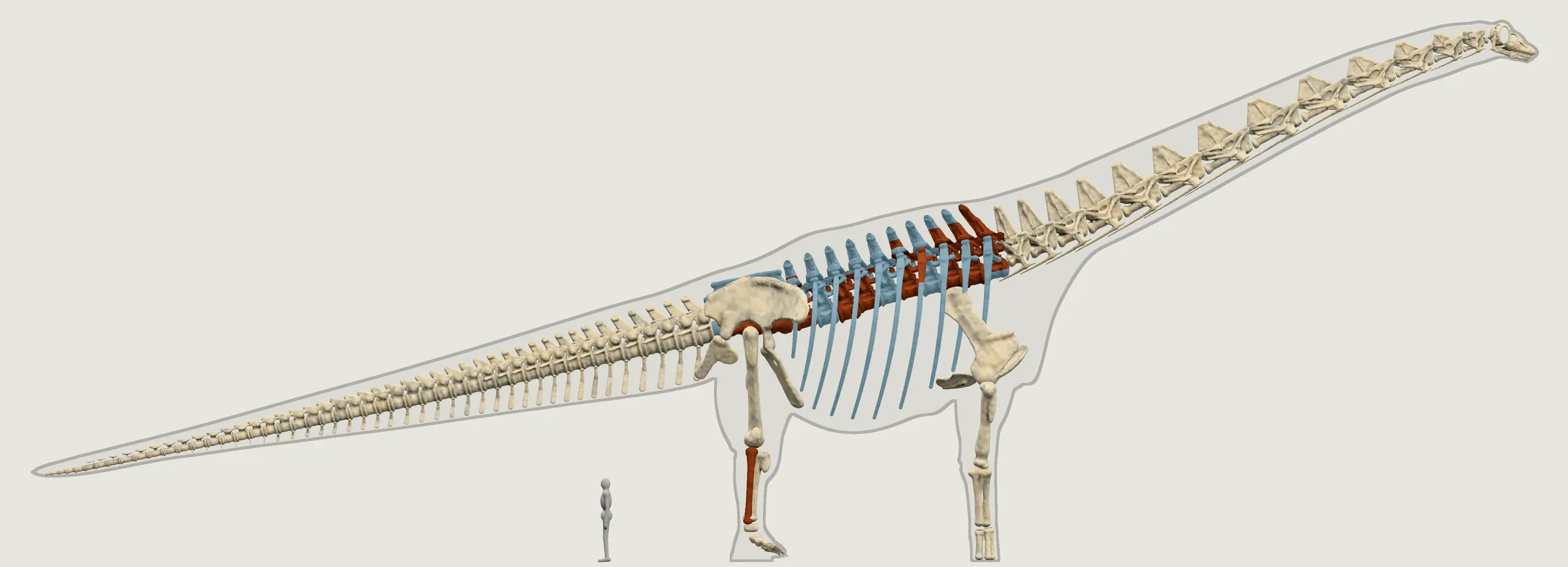
Patagotitan mayorum is the best known of the largest kinds. At least six young adults came from a single quarry on a ranch in Chubut, Argentina: the first bone in 2012, more than a hundred bones in all. They are kept at the Museo Paleontológico Egidio Feruglio in Trelew, where a real thigh bone over 2 m long stands beside the cast.
Brachiosaurus altithorax rests on one partial skeleton, FMNH P 25107, dug up in 1900 in western Colorado and kept at the Field Museum in Chicago. Found were seven back vertebrae, the sacrum, two tail vertebrae, a shoulder bone, the right upper arm bone, the right thigh bone, both hip blades and some ribs. No head, neck, forearms, lower legs or feet, and almost no tail, from an animal not yet full grown. About ten finds of the kind are known, none close to complete.
The tall skeleton in Berlin's Museum für Naturkunde is not Brachiosaurus but Giraffatitan brancai, a close African relative. It was dug up at Tendaguru in what is now Tanzania between 1909 and 1913, in the colonial period the museum itself names. The two were split into separate genera in 2009, on at least 26 differences in the bones, and almost every picture of Brachiosaurus shows the African animal. The Berlin mount combines several animals and is, by the museum's own words, the largest mounted dinosaur skeleton in the world.
Why ours look like this
Each is built at the size of one named find or mount. Argentinosaurus on the Plaza Huincul bones, with a body mainly after Patagotitan. Brachiosaurus on the Chicago skeleton, with neck and head after its relatives. T. rex on SUE, Spinosaurus on the young animal from Morocco. Triceratops on the Smithsonian's mount of about ten animals, whose skull was enlarged when it was rebuilt. Ankylosaurus on the smallest of the three known skeletons, Stegosaurus on Sophie in London. No colour is known for any of them, so the colours are ours, and neighbours differ where nothing is known. The neck angles of the two long necks are our choice, since no neck bone of either animal exists. That is why their heads stand at almost the same height, though our Argentinosaurus is nine metres longer. Our T. rex shows its mouth open. Shut, its lips most likely covered the teeth.
More questions
Was Spinosaurus bigger than T. rex?
Longer, and most likely lighter. A grown Spinosaurus was just under 14 m (46 ft) and about 7.4 tonnes in the current model. A big adult T. rex was about 12 m (39 ft) and 8 to 9 tonnes. Ours in the picture is a young Spinosaurus of about 10 m, so there it is the shorter one.
Was any dinosaur bigger than a blue whale?
No, by what is known. NOAA, the US ocean agency, calls the blue whale the largest animal ever to live on our planet. Most grown ones are 23 to 27 m long, the largest about 30 m (98 ft). Argentinosaurus at about 30 to 35 m was about as long. Only one land claim was ever put near the weight of the largest whales, the lost Indian find, and its bones are gone.
In the museum
Museum of Ages is a digital museum. It is building a wing where these seven and other animals will stand, to one scale. Open today is the Leonardo da Vinci wing. Free entry, no account.
-
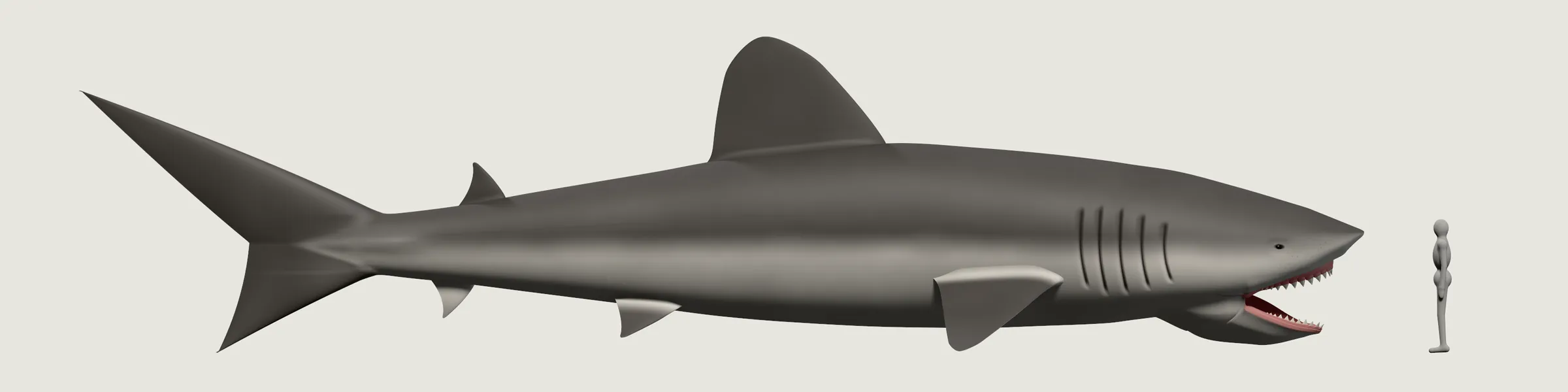
How big was megalodon?
About 16 m (52 ft) by the one long backbone found, the largest perhaps about 20 m. Compared with a person and a blue whale.
Sources
The numbers come from these studies and from the institutions that keep the fossils. The museum is independent of all of them.
- Bonaparte and Coria, 1993, Ameghiniana.
- Mazzetta, Christiansen and Fariña, 2004, Historical Biology.
- Sellers, Margetts, Coria and Manning, 2013, PLOS ONE.
- Paul, 2019, Annals of Carnegie Museum.
- Paul and Larramendi, 2023, Lethaia.
- Carballido and others, 2017, Proceedings of the Royal Society B.
- Otero, Carballido and Pérez Moreno, 2020, Journal of Vertebrate Paleontology.
- Dempsey and others, 2025, Biological Reviews.
- Lacovara and others, 2014, Scientific Reports.
- Bates and others, 2015, Biology Letters.
- Pal and Ayyasami, 2022, Geology Today.
- Carpenter, 2018, Geology of the Intermountain West.
- Woodruff and Foster, 2015, PeerJ Preprints.
- Wedel, Cifelli and Sanders, 2000, Acta Palaeontologica Polonica.
- Taylor, 2009, Journal of Vertebrate Paleontology.
- Sereno and others, 2022, eLife.
- dal Sasso and others, 2005, Journal of Vertebrate Paleontology.
- Therrien and Henderson, 2007, Journal of Vertebrate Paleontology.
- Hutchinson and others, 2011, PLOS ONE.
- Persons, Currie and Erickson, 2019, Anatomical Record.
- Mallon and Hone, 2024, Ecology and Evolution.
- Brassey and others, 2015, the mass model of the Stegosaurus Sophie.
- Arbour and Mallon, 2017, FACETS.
- Curtice, 2021, a talk at the meeting of the Society of Vertebrate Paleontology, as reported by Live Science.
- Skeletal drawings by Scott Hartman, skeletaldrawing.com, compared for Argentinosaurus and Spinosaurus.
- Museo Municipal Carmen Funes, Plaza Huincul: the Argentinosaurus bones MCF-PVPH-1.
- Museo Paleontológico Egidio Feruglio, Trelew: Patagotitan.
- Field Museum, Chicago: Brachiosaurus FMNH P 25107 and SUE, FMNH PR 2081.
- Museum für Naturkunde Berlin: Giraffatitan brancai.
- Natural History Museum, London: Sophie, NHMUK PV R36730, and its dinosaur pages.
- American Museum of Natural History, New York: Ankylosaurus AMNH 5214.
- Smithsonian National Museum of Natural History, Washington: the Triceratops mount.
- Faculté des Sciences Aïn Chock, Casablanca: Spinosaurus FSAC-KK 11888.
- Fernbank Museum of Natural History, Atlanta.
- Sooner Magazine, University of Oklahoma, 2002.
- NOAA Fisheries.
If a number or a holder is wrong, tell us and we will correct it. To the legal notice
Use our pictures
The pictures on this page are the museum's own work under CC BY-SA 4.0, credit: Museum of Ages, and where a caption names a source, that source too. They show reconstructions, built in code and rendered in our own engine, not photographs.