How big is a blue whale?
Most grown blue whales are about 23 to 27 m (75 to 89 ft) long, the largest reliably measured about 30 m (98 ft). According to a 2025 study, they weigh roughly 100 to 150 tonnes, though none was ever weighed whole. The blue whale, Balaenoptera musculus, is the heaviest and largest animal known, living or extinct. Our blue whale is 22.9 m (75 ft), the recorded length of one male taken in 1903.
Blue whales live today in every ocean except the Arctic. A person standing beside ours reaches a little past halfway up its side.
- Body at its deepest, 2.86 m (9.4 ft), ours

- Our blue whale, 22.86 m (75 ft), snout tip to tail notch
- The person, 1.70 m
- Snout tip to the blowholes, 3.6 m, ours
- Two blowholes
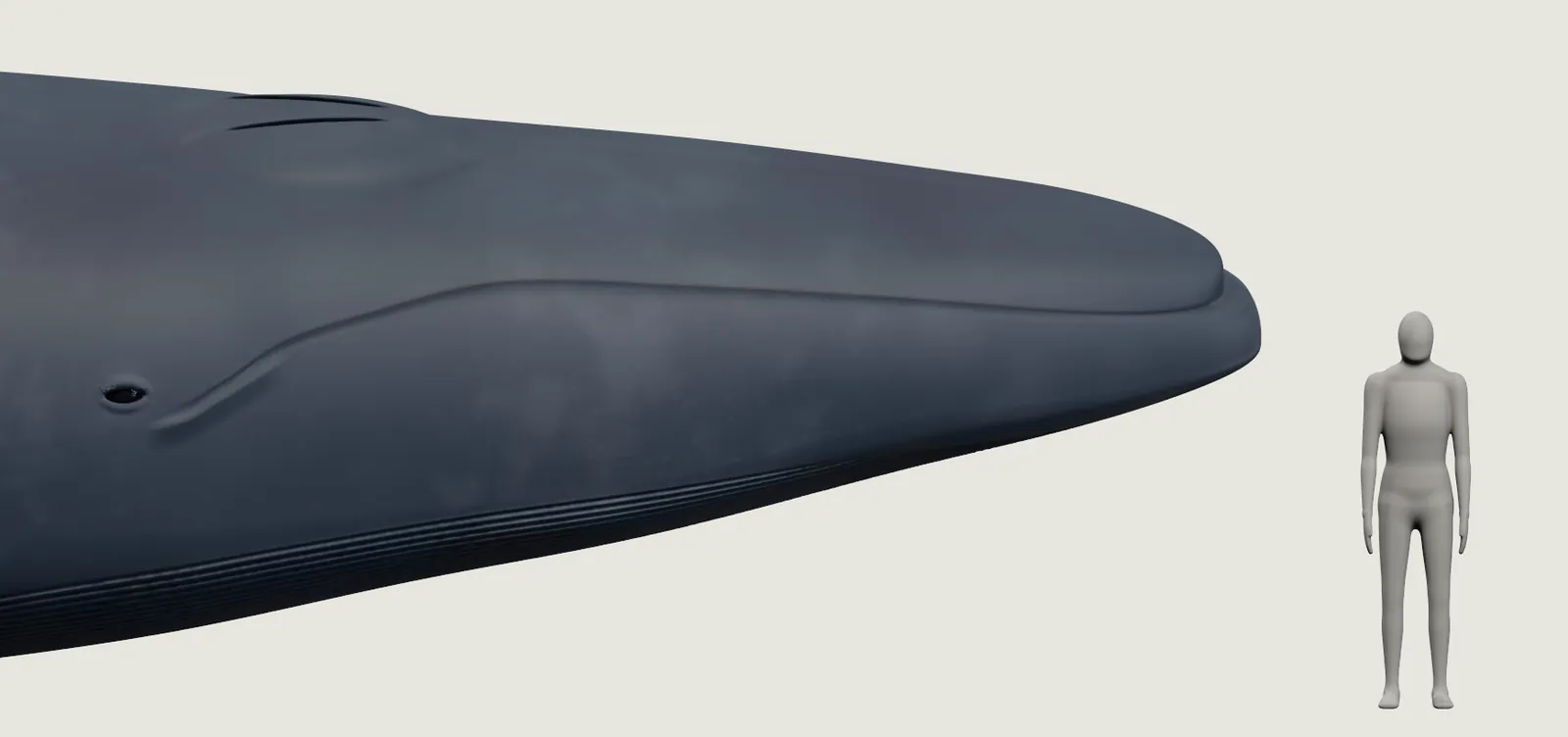
- Throat grooves
- The person, 1.70 m
A guess
A newborn blue whale is about 7 m long. Does it weigh more or less than a tonne?
Show the answerHide the answer
More: about 2.7 tonnes, by the Natural History Museum in London. At about 7 m, the calf is already longer than four people laid head to foot.
The wing for this animal is still being built. The Leonardo da Vinci wing is open today.
Blue whale facts: the numbers as a table
| Animal | Length | Weight | How sure |
|---|---|---|---|
| Most grown blue whales | about 23 to 27 m (75 to 89 ft), females longer than males | roughly 100 to 150 t, according to a 2025 study, never weighed whole | good for the length: a field guide and the US ocean agency agree. The weight is a model |
| The largest blue whales | about 30 m (98 ft), perhaps more | perhaps near 200 t, the top of a model | fair: one 2025 study and the review it cites |
| The longest on record, a female | 33.27 m (109 ft), a disputed whaling record in a Norwegian list from 1928, measured beside a factory ship | disputed: two recent studies disagree | |
| The heaviest weighing, 1940s | 27.6 m (91 ft) | 190 t for a pregnant female, weighed in pieces, a record we could not read at its source | a record quoted by a 2025 study |
| The best documented weighing, a female, 1948 | 27.1 m (89 ft) | about 130 t without her blood, about 140 t with an estimate for it, weighed in pieces | good: the weighing report itself |
| USNM 49757, the male ours follows, Washington | 75 ft (22.86 m), as recorded in 1903 | not known | the record of 1903. Whether he was full grown is disputed: his describer called him adult, but the ends of his forearm bones had not yet fused |
| Our model | 22.86 m (75 ft), snout tip to tail notch, and 2.86 m (9.4 ft) deep at its deepest, ours. Skull 5.81 m (19.0 ft), snout tip to the blowholes 3.64 m (11.9 ft), one flipper 3.19 m (10.5 ft), the flukes 4.44 m (14.6 ft) from tip to tip | measured on our files, the skull sized on the skull of USNM 49757, which is 5.79 m long | |
| Hope, London, a young female | 25.2 m (83 ft) as her skeleton is mounted | her skeleton 4.5 t | the museum that keeps her |
| Our megalodon | about 16 m (52 ft) | roughly 30 t (model of 2025), about 61 t (model of 2022) | two models on one backbone, weight disputed |
| The largest megalodon | perhaps about 20 m (66 ft) | one tooth, scaled from whole tooth sets | |
| Argentinosaurus | about 30 to 35 m (98 to 115 ft), rebuilt, never measured, ours about 30.6 m (100 ft) | roughly 65 to 80 t, a model | one partial skeleton, the body borrowed from relatives |
| The person | 1.70 m (5 ft 7 in) tall, head to foot | our scale figure |
Is the blue whale the largest animal in the world, or ever?
Yes, as far as anyone knows. It is the heaviest animal known, and NOAA, the US ocean agency, and a 2017 study call it the largest animal to have lived. A 2025 study is more careful. It calls the largest animal of all uncertain, since a few giant dinosaurs known only from scraps or lost bones may have matched it. Perucetus, a fossil whale put forward in 2023 as possibly heavier, comes out far lighter in two later studies.
Blue whale length and weight
Most grown blue whales are 23 to 27 m (75 to 89 ft), females longer than males. The Antarctic ones are the biggest. Those of the North Atlantic and North Pacific reach about 27 m (89 ft), and the pygmy blue whale is shorter.
Grown blue whales weigh roughly 100 to 150 tonnes according to a 2025 study, the largest perhaps close to 200. No whole blue whale has ever been weighed. Every weight comes from whales cut up on whaling ships and weighed piece by piece, and the blood lost on deck makes those sums too low. A model built from 31 whales weighed this way puts a blue whale 23 m long at roughly 75 to 85 tonnes.
The biggest blue whale ever recorded
The longest in the records is a female of 33.27 m (109 ft) in a Norwegian whaling list from 1928, measured beside a factory ship. This disputed whaling record splits two recent studies: one calls her the longest reliably measured, the other calls the length not credible. A 2025 study notes that once biologists sailed with the fleets, no whale over 30.5 m turned up in the records, so the largest were about 30 m (98 ft), perhaps more. The heaviest weighing on record is 190 tonnes, for a pregnant, very fat female of 27.6 m (91 ft), weighed in pieces by a Soviet fleet in the 1940s. It is a record we could not read at its source.
Blue whale heart
The only preserved blue whale heart weighed about 180 kg and measured about 1.5 by 1.2 m before it was preserved. It came from one of the blue whales that died trapped in ice off Newfoundland in 2014, and the Royal Ontario Museum in Toronto keeps it. Hearts weighed on whaling ships in the 1940s came to roughly 180 to 625 kg. One male was tagged off California. On deep dives its heart slowed to as few as 2 beats a minute, and at the surface it rose to 25 to 37.
Blue whale tongue: how heavy is it?
We found no record of a blue whale tongue being weighed, though it is said to weigh 4 tonnes, or 7, or as much as an elephant. None of these claims gives a method, and the two numbers disagree. What is known: the tongue is huge, soft and flat, and after a big gulp it pushes the water out through the baleen.
Blue whale vs megalodon
Going by the fossils, the two never met: the last megalodon lived about 3.6 million years ago, and the oldest blue whale fossil we know of is about 1.5 to 1.25 million years old. Who would win has no answer.
Our megalodon, about 16 m, comes to a little past two thirds of our blue whale's length. Fewer small baleen whales to hunt is one of the causes named for the end of megalodon, though none is settled. Argentinosaurus, about 30 to 35 m and roughly 65 to 80 tonnes by its models, was about as long as the longest blue whales and about half as heavy as a big one. No known dinosaur was heavier.
In our picture our blue whale is about three quarters as long as our Argentinosaurus.
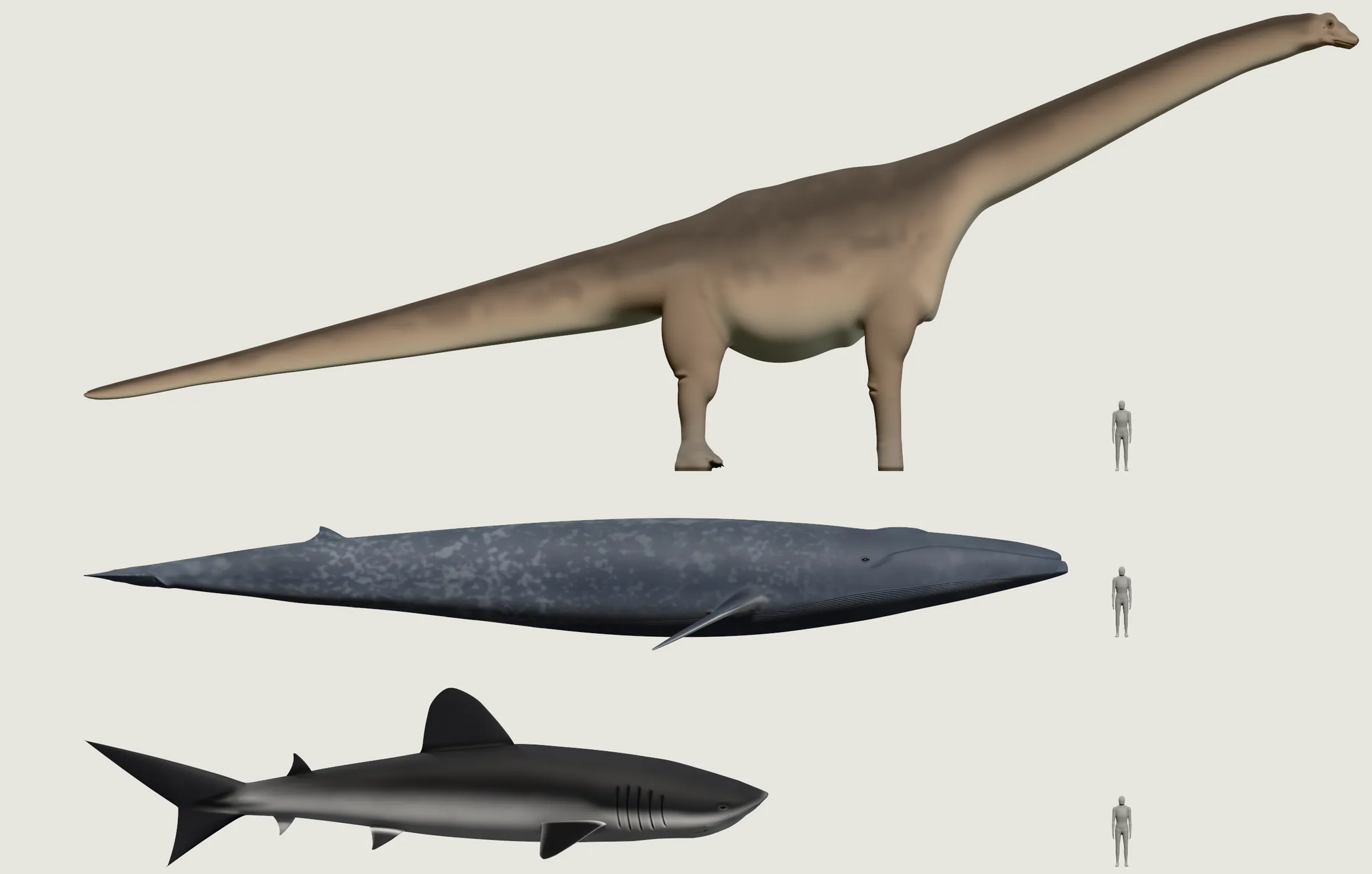
- Our Argentinosaurus, about 30.6 m
- Our blue whale, 22.86 m
- Our megalodon, about 16 m
- The person, 1.70 m
Blue whale skeleton
The best known blue whale skeleton is Hope, a young female of about 15 who stranded near Wexford, Ireland, in March 1891. Her skeleton, 25.2 m (83 ft) as mounted, weighs 4.5 tonnes and came to London in 1892. Since 2017 it has hung diving from the ceiling of the Natural History Museum's Hintze Hall.
Our model follows another whale, the male USNM 49757, taken in 1903 near Hermitage Bay, Newfoundland, whose skeleton is kept at the Smithsonian in Washington. Whether he was full grown is disputed. In Toronto, the Royal Ontario Museum has shown the skeleton of a 23.3 m whale that washed ashore at Trout River, Newfoundland, in 2014.
Our skeleton picture shows which bones were sized on the measurements of USNM 49757.

- Skull, 5.8 m (19 ft), ours
- The person, 1.70 m
- Sized on his own measured bones (USNM 49757)
- Sized after other whales
- “Measured” means sized to the published measurements of his bones, not scanned. The wrist bones and the loose ends of the forearm bones are estimated, not measured, and carry the second colour. The hyoid, a throat bone, is not built.
How long do blue whales live?
NOAA estimates that they live around 80 to 90 years on average. The age is counted from the layers in the waxy ear plugs of dead whales.
How many blue whales are left?
Nobody has counted them all: by one estimate, given by the Royal Ontario Museum in 2016, there were then 5,000 to 10,000. By another, the Red List assessment of 2018, there were 5,000 to 15,000 grown whales, and the species was endangered. We could read that assessment only second hand.
Whalers reported about 330,000 blue whales killed in the Antarctic alone between 1909 and 1965. Blue whales have been protected from whaling since the mid 1960s, and an international ban on commercial whaling began in 1986. Their numbers are rising again, says NOAA, and the main dangers now are ships and fishing gear.
How a blue whale eats
Blue whales eat krill, small shrimp-like animals. A blue whale lunges into a swarm with its mouth open, and the grooves under its throat stretch until the mouth bulges. The water goes out through the baleen, horny plates hanging from the upper jaw in place of teeth, and the krill stay inside.
Numbers you may have read
For each number: where it came from, and what it means.
- 33 m (109 ft)
- A disputed whaling record, one female in a list from 1928. Lengths over 30.5 m vanished once biologists measured.
- 190 tonnes, and 200
- The 190 tonnes come from a pregnant female weighed in pieces in the 1940s, a record we could not read at its source. The 200 tonnes are the top of a model.
- 270 tonnes
- A 2024 model for a whale of 33 m, the length of the disputed whaling record. A 2025 study puts one of 30.5 m at about 195 tonnes.
- A heart the size of a car
- No measurement we found backs it. The only preserved heart measured about 1.5 by 1.2 m before it was preserved, far smaller than a car, by our own comparison.
- Arteries a person could swim through
- Nothing we read supports it, and we found no measured width of a blue whale's main artery.
- A tongue as heavy as an elephant
- The tongue is said to be that heavy, but no weighing stands behind it.
- The largest animal that ever lived
- True with one word added, the largest animal known.
- Perucetus at up to 340 tonnes
- Two later studies brought this fossil whale down, to roughly 60 to 70 tonnes and to 35 to 40.
More questions
How big is a blue whale compared to a human?
Our blue whale is as long as about 13 people of 1.70 m laid head to foot. Its skull alone matches three people and a bit, and one flipper almost two. These are our own sums, on our model.
Why is it called blue?
Its skin is blue-grey and mottled, and under water it looks light blue.
In the museum
Museum of Ages is a digital museum, made by a nonprofit. Free entry, no account. In the animal wing this animal will stand among the others, from the giants of long ago to the last of their kind. The Leonardo da Vinci wing shows what a finished wing looks like.
-
How big was megalodon?
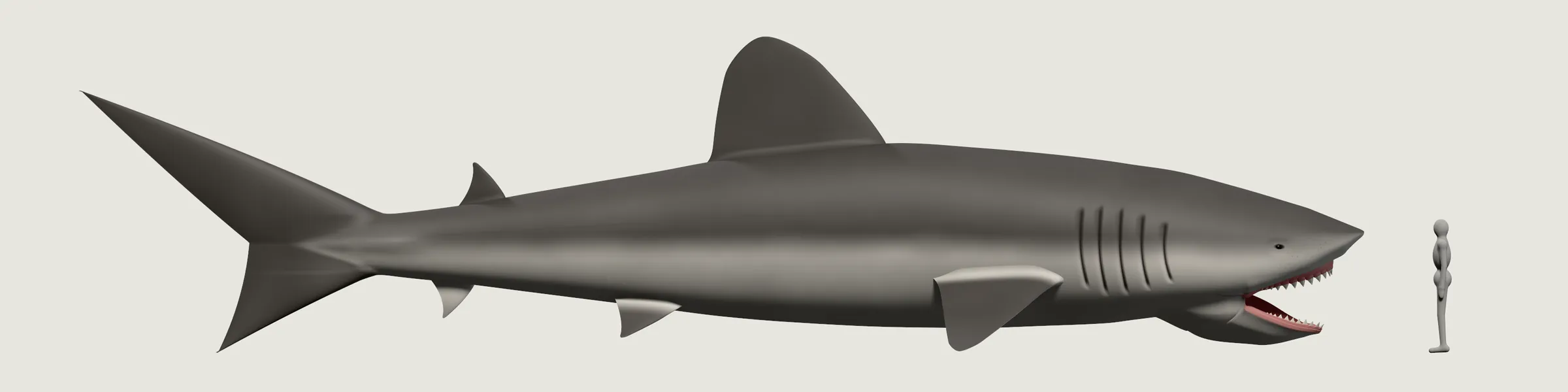
The one long megalodon backbone found gives about 16 m (52 ft), and the largest megalodons were perhaps about 20 m, compared with a person, a great white and a blue whale.
-
What was the biggest dinosaur?
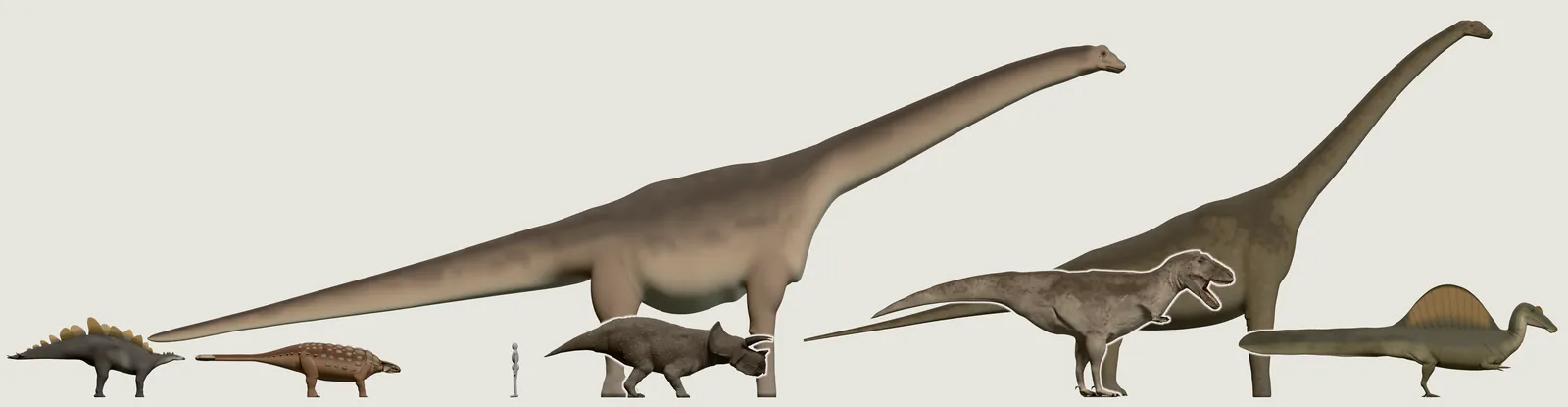
Seven of ours beside a person, to one scale: the heaviest most likely a titanosaur from Patagonia, the tallest probably Sauroposeidon, and why the longest is still open.
Sources
The numbers come from these studies and from the museums and agencies that keep the bones and the records. The museum is independent of all of them.
- Motani and Pyenson, 2024, PeerJ, on the weight of a blue whale at each length, the records and Perucetus.
- Paul and Larramendi, 2025, Palaeontologia Electronica, on the largest blue whales, the records and Perucetus.
- Nishiwaki, 1950, Scientific Reports of the Whales Research Institute, the weighings in pieces of 1947 to 1949.
- Goldbogen and others, 2019, PNAS, on the heartbeat of a tagged blue whale.
- Slater, Goldbogen and Pyenson, 2017, Proceedings of the Royal Society B.
- Bianucci and others, 2019, Biology Letters, the study's summary, on the oldest blue whale fossil we know of.
- Boessenecker and others, 2019, PeerJ, the study's summary, on the end of megalodon.
- Bianucci and others, 2023, Nature, the study's summary, on Perucetus.
- Cooke, 2018, the IUCN Red List assessment of the blue whale, read only as quoted elsewhere.
- Miller, 1924, the description of the male USNM 49757, and a review of it in Nature, 1925, as our science check cites them.
- Jefferson, Leatherwood and Webber, 1993, the FAO species identification guide Marine Mammals of the World.
- NOAA Fisheries: its blue whale page, updated in 2026.
- Natural History Museum, London: its page on the history of Hope.
- Royal Ontario Museum, Toronto: its news release on the heart, 2017, two of its blog posts, 2015 and 2016, and its annual report 2015 to 2016.
- Megalodon: the numbers and sources of our megalodon page.
- Argentinosaurus: the numbers and sources of our biggest dinosaurs page.
If a number or a holder is wrong, tell us and we will correct it. To the legal notice
Use our pictures
The four pictures of the blue whale on this page, the side view, the head, the skeleton and the row with our megalodon and our Argentinosaurus, are our own work under CC BY-SA 4.0, credit: Museum of Ages, and for the row, megalodon body shape after Shimada and others 2025 (CC BY 4.0). They show a reconstruction, built in code and rendered in our own engine, not photographs. The pictures of the other pages listed here give their credits on those pages.