How big was Triceratops?
Big adult Triceratops were about 7 to 8 m (23 to 26 ft) long, and the largest reached about 9 m (30 ft). No Triceratops was ever weighed: two computer models of the famous Washington skeleton give about 6.5 to 8.5 tonnes. Our Triceratops is built after that skeleton, a mount of bones from about ten animals. It is 6.9 m (23 ft) long, about four people end to end, and stands about 2.5 m (8 ft) high over the hips.
A big adult's skull is about 2 m (6.5 ft) long, beak to the back of the frill: longer than a person is tall. It is one of the largest heads of any land animal.
- Top of the back over the hips, 2.5 m, ours
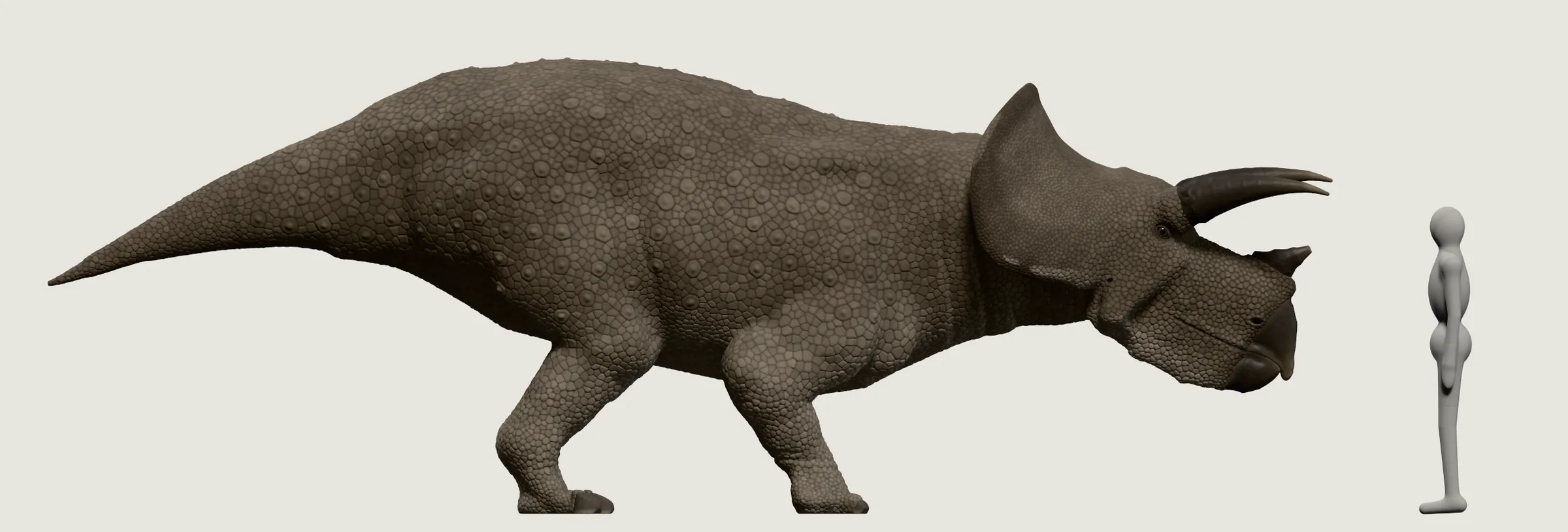
- Our Triceratops, 6.9 m from beak to tail
- The person, 1.70 m
- Skull along the white line, 2.2 m with skin, ours
- Brow horn tips, about 1.8 m up, ours
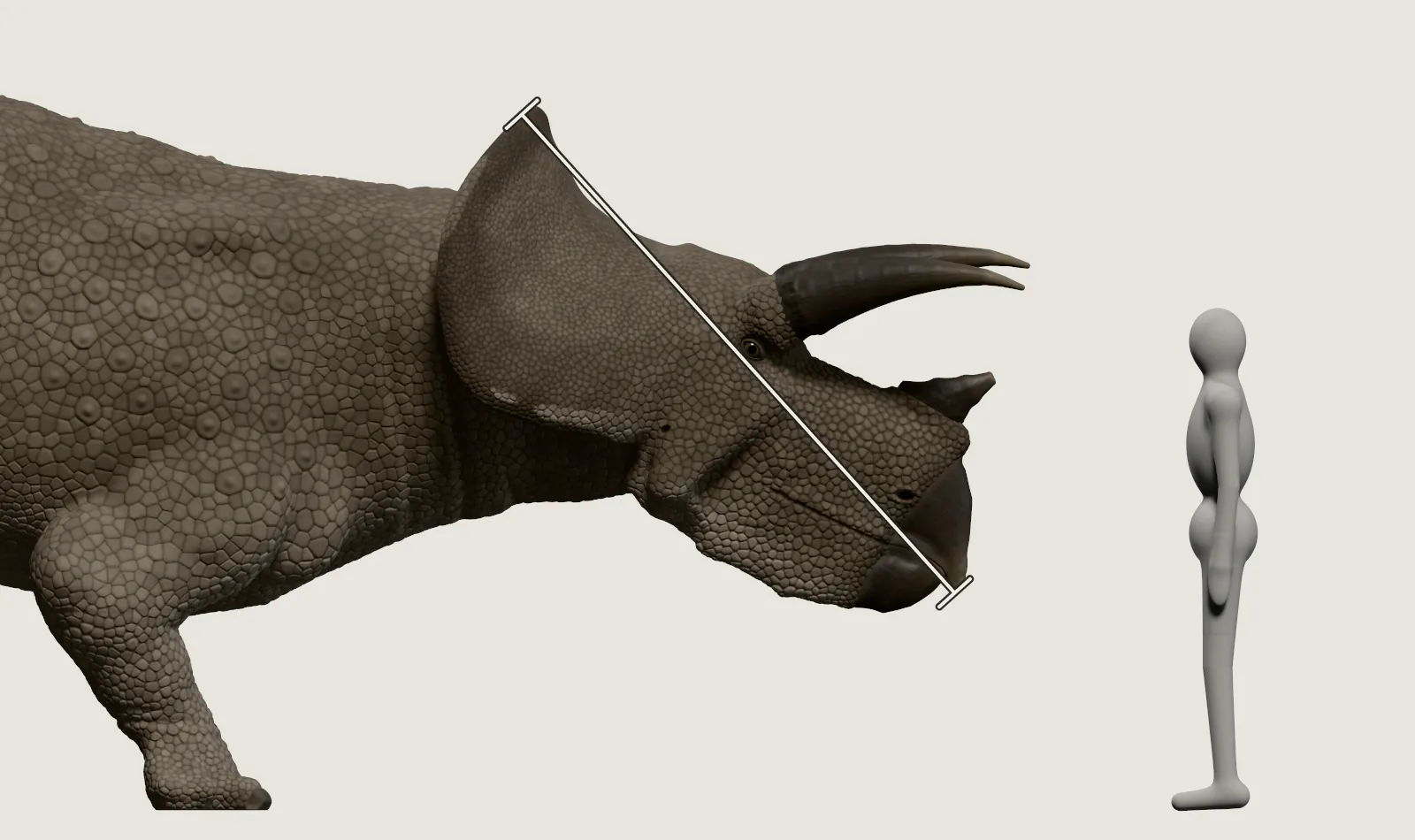
- The person, 1.70 m
A guess
What did the first scientist to study its horns think they came from?
Show the answerHide the answer
A giant bison: in 1887 the American scientist Othniel Marsh named the two horn cores Bison alticornis. After more finds he named Triceratops in 1889.
The wing for this animal is still being built. The Leonardo da Vinci wing is open today.
Triceratops size and weight: the numbers
| Animal | Length | Height, with the point named | Skull length | Weight | How sure |
|---|---|---|---|---|---|
| Triceratops, big adults | about 7 to 8 m (23 to 26 ft), by the large skeletons known | not measured | about 2 m (6.5 ft), beak to the back of the frill | fair: the lengths from reports of named skeletons, the skull from a study of ten skulls | |
| The largest Triceratops | about 9 m (30 ft), a museum's round figure, no method | not measured | weak | ||
| The Washington skeleton, Hatcher | not published | about 2.3 to 2.5 m (7.5 to 8 ft) at the top of the back over the hips, our reading of photographs, not published | 2.12 m (7 ft) in bone, measured by us on its scan, enlarged in the rebuild | about 6.5 to 8.5 t, two computer models | a mount of bones from about ten animals, the weights from models, never weighed |
| Our model | 6.9 m (23 ft) straight, 7.1 m to the brow horn tips | 2.5 m (8 ft) over the hips at the back's top, the frill's top about 2.4 m (7.8 ft) | 2.2 m (7.2 ft) with skin | measured on our files, built after the Washington scan | |
| T. rex, SUE | about 12 m (39 ft), the mount | at the hip about 4 m (13 ft), by the museum | about 1.4 m (4.6 ft), snout to the back of the cheek | about 8 to 9 t, by a bone and three models | as on our T. rex page |
| The person | 1.70 m (5 ft 7 in) tall, head to foot | our scale figure |
Triceratops skull, horns and frill
A big adult's skull was about 2 m (6.5 ft) long, by a study of ten skulls from baby to adult. On the scan of the rebuilt Washington skull, we measure 2.12 m (7 ft) in bone.
Two long horns stand over the eyes and a short, low one on the nose. The long nose horn of many pictures belongs to the later species, Triceratops prorsus, and ours is the older Triceratops horridus. The bone in a museum is only the horn's core: in life a sheath of horn covered it, so the horns were longer, by how much nobody knows. They changed with age too: a young Triceratops's brow horns curved backward, an adult's forward.
The frill is a wide shield of solid bone behind the head, with no holes in it, under skin. What horns and frill were for, nobody has proved. The best evidence is healed wounds on frills, best explained by the horns of other Triceratops, so they most likely fought each other. Showing off and telling each other apart are likely uses too, and defence against predators is possible.
Triceratops vs T. rex
In one count of the large dinosaurs of Montana's Hell Creek Formation, where both lived at the same time, Triceratops was the most common of all. T. rex did bite Triceratops: a Triceratops hip bone found in 1991 carries 58 definite tooth marks that only a T. rex could have made, says a university's report of 1996. One brow horn, bitten off, healed afterwards, so at least one Triceratops survived a T. rex bite.
Whether T. rex mostly hunted them or mostly ate the dead, the bones do not say, and no find shows a fight between the two. The famous “Dueling Dinosaurs” from Montana, a Triceratops and a tyrannosaur found together, do not prove one either. Since 2025 their tyrannosaur is counted as Nanotyrannus, a smaller kind, not T. rex, and that is still argued.
Our two at one scale, for size only: our T. rex is about 1.6 times as long as our Triceratops.
- Our T. rex, after SUE, about 11.4 m
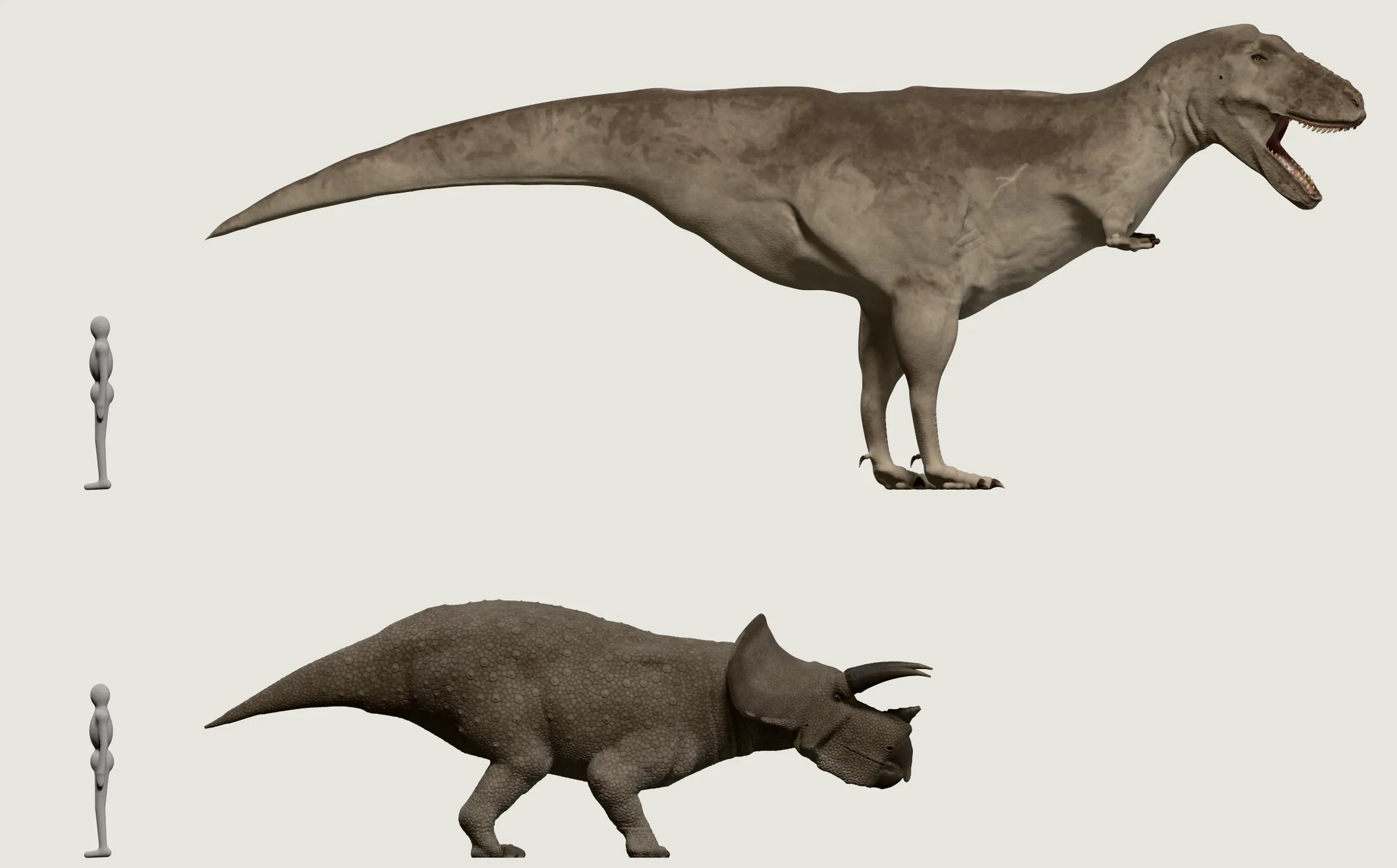
- Our Triceratops, 6.9 m
- The person, 1.70 m
Torosaurus: a very old Triceratops, or its own animal?
Torosaurus was a horned dinosaur from the same time and the same rocks, with a longer frill that had two big holes in it. In 2010 two scientists proposed that it was no separate animal, only a Triceratops grown very old, whose frill stretched and opened holes late in life. Later studies found young Torosaurus and old Triceratops, and measured skull shapes that grow apart, not together. A Torosaurus that was still young cannot have been an old Triceratops. Most scientists therefore now see Torosaurus as a separate animal, though the question is still argued and neither side counts as proven.
The Triceratops skeleton in Washington
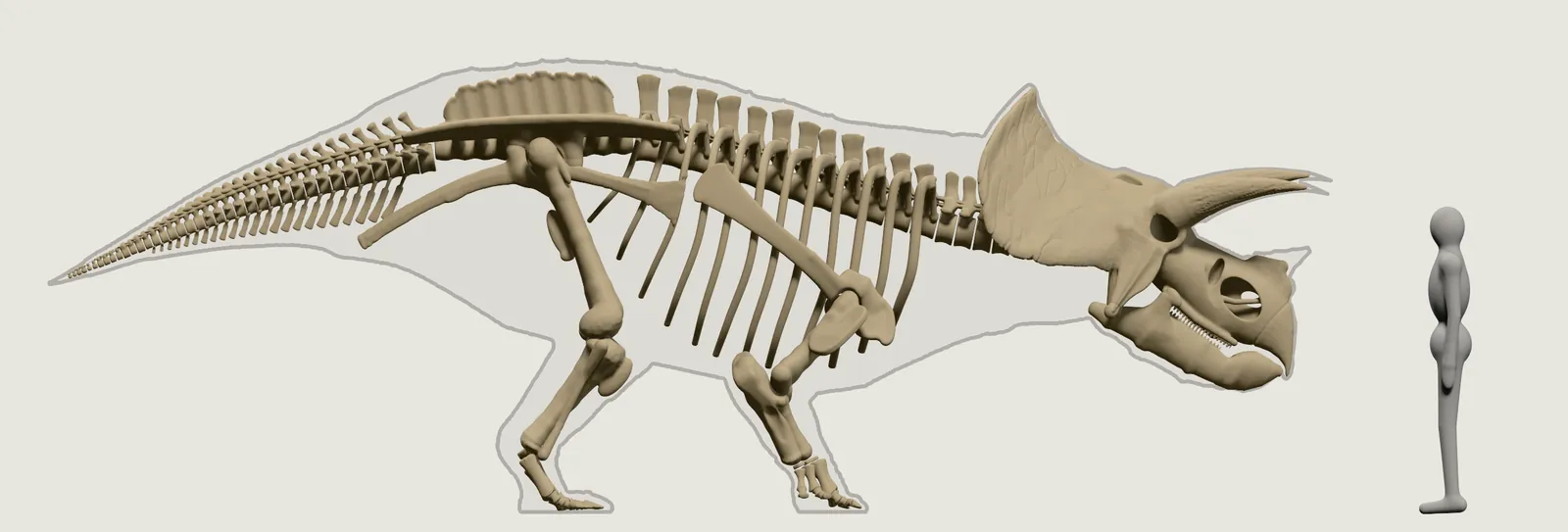
The skeleton in the Smithsonian's natural history museum in Washington is called Hatcher, after the fossil hunter John Bell Hatcher, and its bones came from Wyoming. It went on show in 1905, low and sprawling like a crocodile, and for over twenty years no other Triceratops was on show anywhere. No complete skeleton was known, so the museum pieced it together from about ten animals. Its skull was too small, its front legs of different lengths, and its hind feet, which came from another dinosaur, had the wrong count of toes.
In 1996 a piece of hip bone fell off: minerals growing inside the bones were breaking them up, and in 1998 the skeleton came down. Then, for the first time, a whole dinosaur skeleton was scanned in 3D, the skull enlarged by about 15 percent on the computer and the right side mirrored to make the left. After that the mount stood upright, and since 2019 Hatcher has lain in the fossil hall while a T. rex feeds on it: a museum's scene, not a find. Our Triceratops is built after that scan.
What a real Triceratops looked like
Skin and scales
Scales up to 9 cm wide on the trunk, the largest ordinary scales known on any dinosaur, with a slightly bigger bumped scale every 15 to 20 cm. That comes from a clay cast of the skin's surface on another big Triceratops. Feathers or quills are unlikely.
Beak, teeth and food
A horny beak snipped plants, and rows of teeth at the back of the jaws cut them like shears.
Legs and colour
The front legs stood upright under the body, elbows a little out, never sprawled like a lizard's, and two methods agree on that. Three of the five fingers and all four toes had hooves. No colour is known, so ours is a choice.
When and where Triceratops lived
Triceratops lived in western North America in the Late Cretaceous, between about 68 and 66 million years ago. Two species followed each other: the older T. horridus, ours, slowly changed into the later T. prorsus. Its last fossils reach the close of the Cretaceous, about 66 million years ago, when an impact in the Yucatán is thought to have set off the collapse.
Numbers you may have read
For each number: where it came from, and what it means.
- 9 m long
- A round top figure for the largest, from a museum's dinosaur directory with no method and no skeleton named. A big adult was about 7 to 8 m, and ours is 6.9 m.
- 10 tonnes
- Printed beside the 9 m, again with no method. The newest models of the Washington skeleton give about 6.5 to 8.5 tonnes.
- 13 tonnes
- A museum's card of the biggest dinosaurs, with no method, and above every other figure here.
- The largest head of any land animal
- One big museum says “one of the largest”, not “the largest”. Big adult skulls are about 2 m long.
- A long nose horn
- It belongs to T. prorsus, the later species. T. horridus, the older one and ours, had a short, low horn on a long snout.
- Torosaurus was the grown-up Triceratops
- An idea of 2010. Later studies found young Torosaurus, and most keep the two apart.
More questions
Was Triceratops bigger than T. rex?
No. A big adult Triceratops was about 7 to 8 m (23 to 26 ft) long, a large T. rex about 12 m (39 ft) and far higher at the hips. In weight they were closer: about 6.5 to 8.5 tonnes for the Washington Triceratops, about 8 to 9 for a large T. rex. Only the skull was longer: about 2 m against SUE's 1.4 m.
What does the name Triceratops mean?
Three-horned face, from Greek. Marsh gave the name in 1889, and ours is Triceratops horridus, the older of its two species.
In the museum
Museum of Ages is a digital museum, made by a nonprofit. Free entry, no account. In the animal wing this animal will stand among the others, from the giants of long ago to the last of their kind. The Leonardo da Vinci wing shows what a finished wing looks like.
-
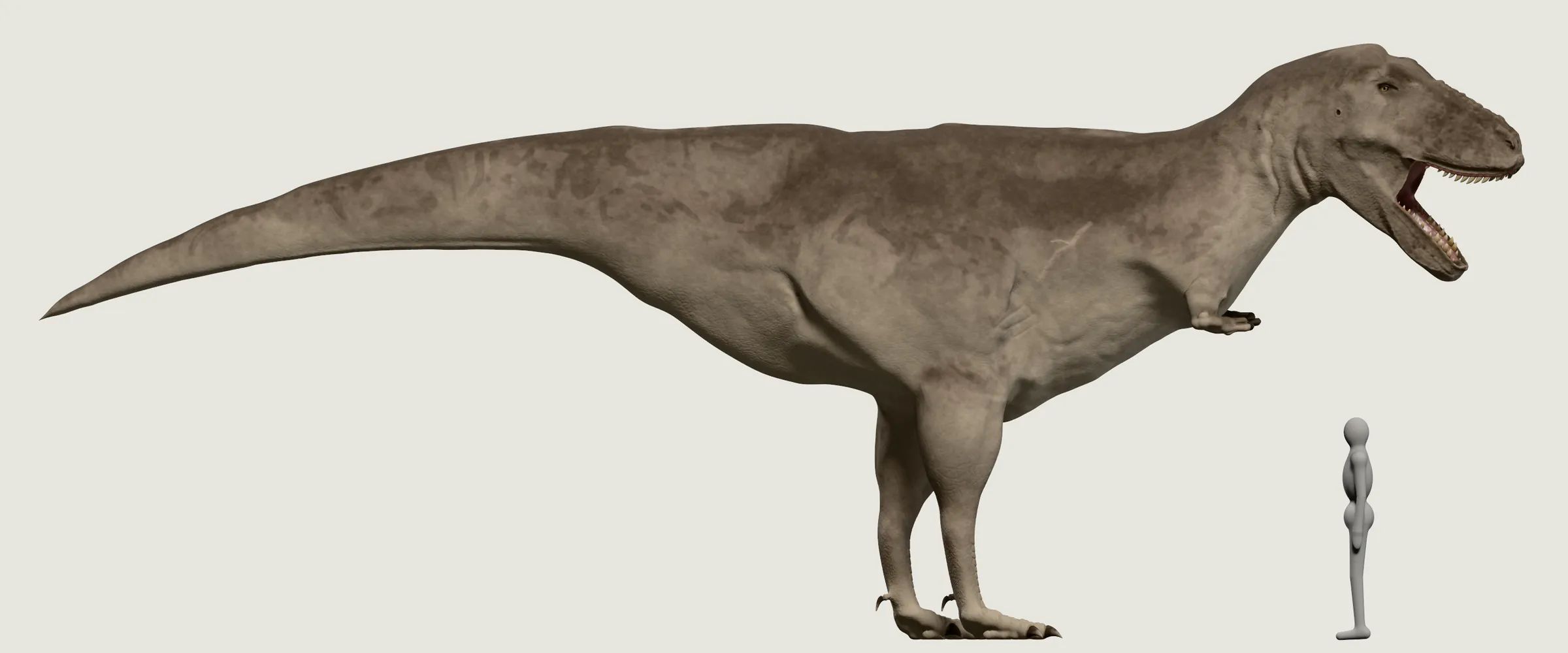
How big was T. rex?
A large adult T. rex was about 12 m long, about 4 m at the hips and roughly 8 to 9 tonnes. Our T. rex is built to SUE's measurements and stands beside a person to one scale, with a list of what was found of SUE.
-
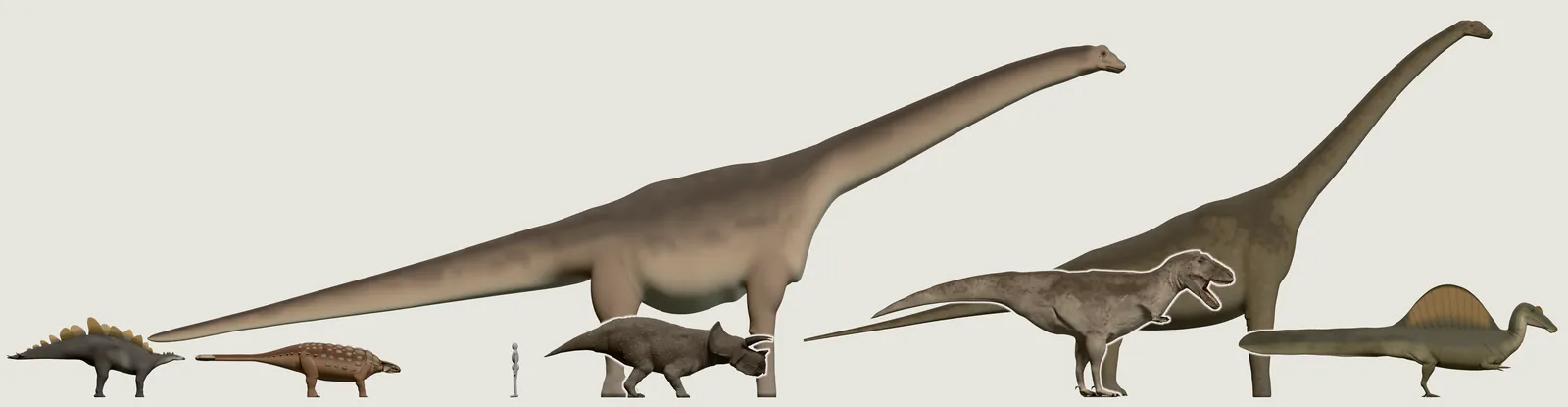
What was the biggest dinosaur?
Seven of ours beside a person, to one scale: the heaviest most likely a titanosaur from Patagonia, the tallest probably Sauroposeidon, and why the longest is still open.
-
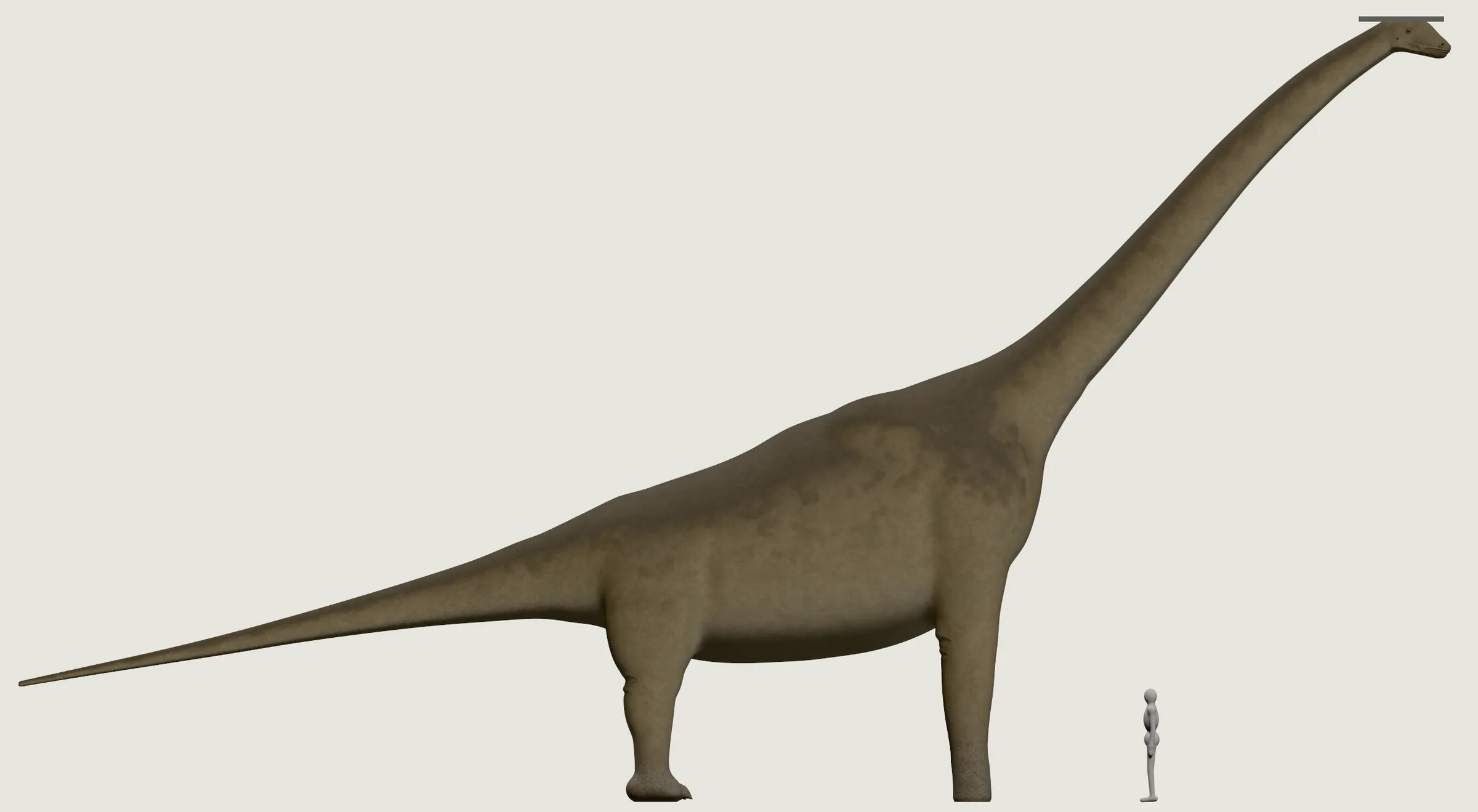
How big was Brachiosaurus?
Brachiosaurus, a long-necked plant eater of the Late Jurassic, was about 22 to 25 m long and roughly 30 to 45 tonnes, both figures rebuilt from one partial skeleton. Our Brachiosaurus stands beside a person, its head about seven people up in the pose we chose.
Sources
The numbers come from these studies and from the museums that keep the bones. The museum is independent of all of them.
- Dempsey and others, 2025, Biological Reviews, the weight models of the Washington skeleton.
- Horner and Goodwin, 2006, Proceedings of the Royal Society B, the study's summary.
- Scannella and Horner, 2010, Journal of Vertebrate Paleontology, the study's summary.
- Longrich and Field, 2012, PLOS ONE, the study's summary.
- Maiorino and others, 2013, PLOS ONE, the study's summary.
- Mallon and others, 2022, Zoological Journal of the Linnean Society, the study's summary.
- Scannella and others, 2014, PNAS, the study's summary.
- Farke, Wolff and Tanke, 2009, PLOS ONE.
- D'Anastasio and others, 2022, Scientific Reports.
- Horner, Goodwin and Myhrvold, 2011, PLOS ONE, the count of Hell Creek dinosaurs.
- Zanno and Napoli, 2025, Nature, the study's summary.
- Bell and others, 2022, Communications Biology, on the scales.
- Sereno and others, 2026, Science, the study's summary, on what the skin casts are.
- Fujiwara and Hutchinson, 2012, and Dempsey and others, 2023, on the stance of the front legs.
- Theurer and others, 2026, PLOS ONE, on the feet.
- Barnosky and others, 2011, Nature, on the end of the Cretaceous.
- University of California, Berkeley: its report of 1996 on the bitten Triceratops hip bone.
- Smithsonian National Museum of Natural History, Washington: the Triceratops mount Hatcher and its own account of the mount's history.
- Natural History Museum, London: its Triceratops page.
- North Carolina Museum of Natural Sciences, Raleigh: the Dueling Dinosaurs.
- T. rex: the numbers and sources of our T. rex page.
If a number or a museum is wrong, tell us and we will correct it. To the legal notice
Use our pictures
The four pictures of the Triceratops on this page, the side view, the head, the pair with our T. rex and the skeleton, are our own work under CC BY-SA 4.0, credit: Museum of Ages, Triceratops outline after Dempsey 2025 (CC BY 4.0). They show a reconstruction, built in code and rendered in our own engine, not photographs. The pictures of the other pages listed here give their credits on those pages.