How big was Ankylosaurus?
Ankylosaurus was about 6 to 8 m (20 to 26 ft) long, by a 2017 study. The smallest of the known animals came to about 4.8 tonnes (3.6 to 6 by the study's own spread), worked out from how thick its leg bones are. Our Ankylosaurus is built at that animal's size: 6.4 m (21 ft) long, almost four people lying head to foot. Its back is highest over the hips, at 1.70 m (5.6 ft), exactly the height of the person beside it.
Only one Ankylosaurus tail club has been found so far, on that same animal. Its knob is about half a metre (1.6 ft) wide, at the end of a tail whose back half was stiff as a rod.
- Top of the back over the hips, 1.70 m, ours
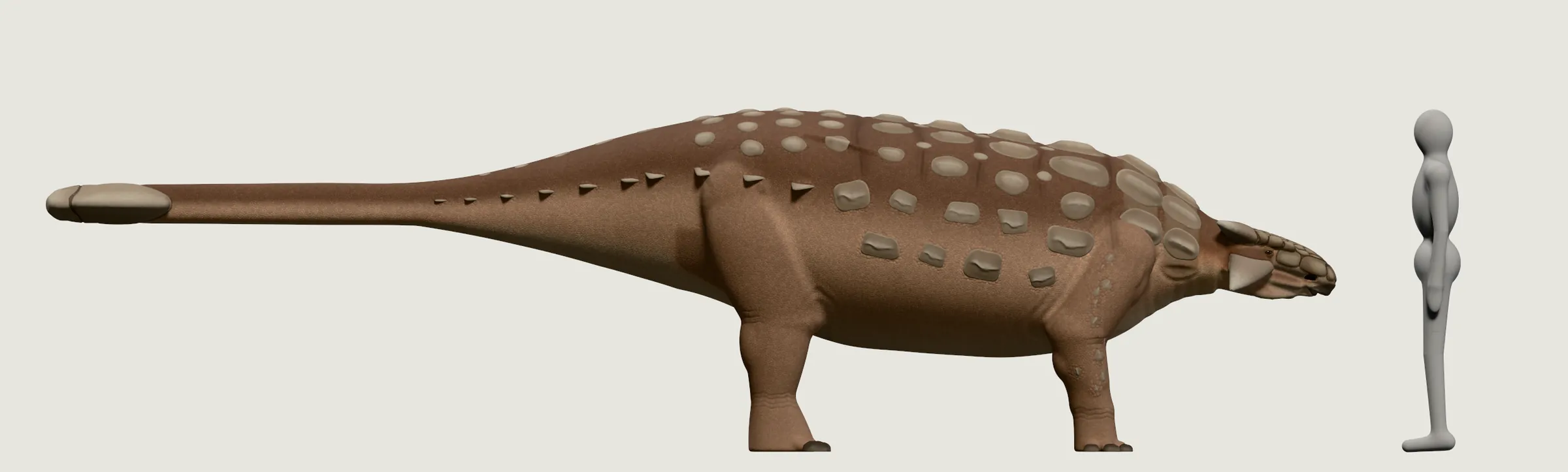
- Our Ankylosaurus, 6.4 m from beak to club
- The person, 1.70 m
- Knob of the club, 61 cm long with its horn cover, ours
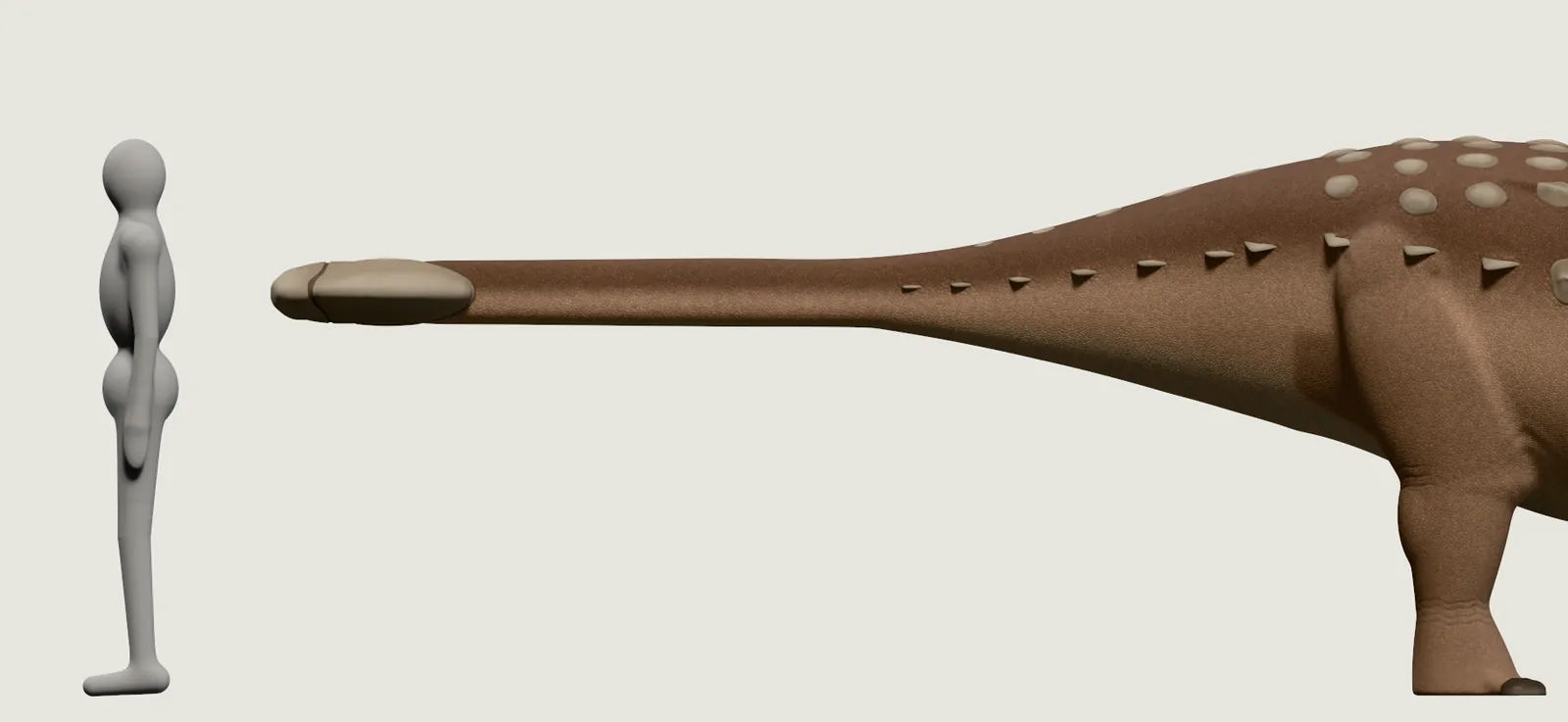
- Handle and knob, about 2 m, ours
- The person, 1.70 m
A guess
The biggest Ankylosaurus skull found so far: were its teeth bigger or smaller than in the smallest skull?
Show the answerHide the answer
Smaller: the big skull's largest unworn tooth is about 7.5 mm high. In the smallest skull, the one ours is built on, the biggest is about 9.1 mm.
The wing for this animal is still being built. The Leonardo da Vinci wing is open today.
Ankylosaurus facts: size, height and weight
| Animal | Length | Height, with the point named | Skull length | Weight | How sure |
|---|---|---|---|---|---|
| The animal with the biggest skull (CMN 8880, Ottawa), known from the skull alone | up to about 8 m (26 ft) as its study judges it, nearly 10 m (33 ft) calculated but called probably too long by its authors | not measured | about 67 cm (2.2 ft) | about 8 t, a rough scaling its own authors doubt | weak: one skull, no body |
| AMNH 5214, New York, the animal ours is built on | about 6 to 8 m (20 to 26 ft), most likely near the low end, worked out from relatives' tails | not measured, and none published for today's lengths | about 56 cm (1.8 ft) long, 64 cm (2.1 ft) across the horns | about 4.8 t from its upper arm and thigh bones, the study's spread 3.6 to 6 t | fair: one 2017 study, never weighed |
| Our model | 6.4 m (21 ft) straight, beak to club | 1.70 m (5.6 ft) at the top of the back over the hips, 1.5 m (4.9 ft) over the shoulders, ours | the skull of AMNH 5214 | measured on our files, the height built up from the bones | |
| The tail club of AMNH 5214, and ours | knob 60 cm (2 ft) long and 49 cm (1.6 ft) wide, measured on the fossil. Ours 61 by 51 cm with its horn cover. Handle and knob about 2 m (6.6 ft), in the study and in ours | knob 19 cm (7.5 in) high, measured on the fossil | good for the knob: measured. Fair for the 2 m: the handle completed from a relative. Ours: measured on our files | ||
| T. rex, SUE | about 12 m (39 ft), the mount | at the hip about 4 m (13 ft), by the museum | about 1.4 m (4.6 ft), snout to the back of the cheek | about 8 to 9 t, by a bone and three models | good: the museum and two studies agree |
| Stegosaurus, Sophie, London | about 5.6 m (18 ft), the mount | at the hips not published | about 1.6 t, a model of its own skeleton | one almost complete animal, as on our biggest dinosaurs page | |
| The person | 1.70 m (5 ft 7 in) tall, head to foot | our scale figure |
Ankylosaurus tail club
The club's knob is 60 cm (2 ft) long, 49 cm wide and only 19 cm high, measured on the fossil. It is a low, flat, rounded disc of bony plates with no spikes, and oddly no wider than the biggest clubs of its smaller relatives. The handle was the back half of the tail, its vertebrae locked together and bound by bony tendons into a stiff rod.
Only the front of the tail could bend, mostly sideways: a study of relatives' tails found a swing of about 100 degrees. Could the club break bone? In that study's model only knobs over 50 cm wide hit hard enough, and this one sits just under that line.
The best clue to its use is a study of an older relative, Zuul, with healed, broken plates on its flanks just where another club would land. So clubs seem to have served mostly in fights within their own kind. The same study has little doubt they could also fend off a predator, but no Ankylosaurus fossil shows either.
Ankylosaurus armour
Ankylosaurus wore bony plates set in its skin, with skin between them, not a solid shell, and two bony half collars over the neck. Loose plates of its own are known, yet no Ankylosaurus has been found with a plate still in place.
So the place of each plate is a careful guess from relatives, and ours follows a 2017 plan. The big shoulder spikes of old pictures belong to another armoured family, and in its relatives the belly had no big plates. No colour is known, so ours is a choice.
Ankylosaurus fossils and skeleton: what was found
Ankylosaurus is known from two partial skeletons and a single big skull, none complete. The first, the skeleton its name rests on, was found in 1906 in Montana by a team under Barnum Brown. His team found the second in 1910 on the Red Deer River in Alberta: AMNH 5214, the one with the club. Both are kept at the American Museum of Natural History in New York.
The biggest skull came to light in 1947, also in Alberta, and is kept at the Canadian Museum of Nature in Ottawa. The rest is loose plates, a piece of a club handle and teeth. Ankylosaurus is rare in the rocks: in one count of big dinosaurs in Montana's Hell Creek Formation, only 2 of about 180 skeletons were Ankylosaurus.
Our skeleton picture shows which bones were found with that animal.
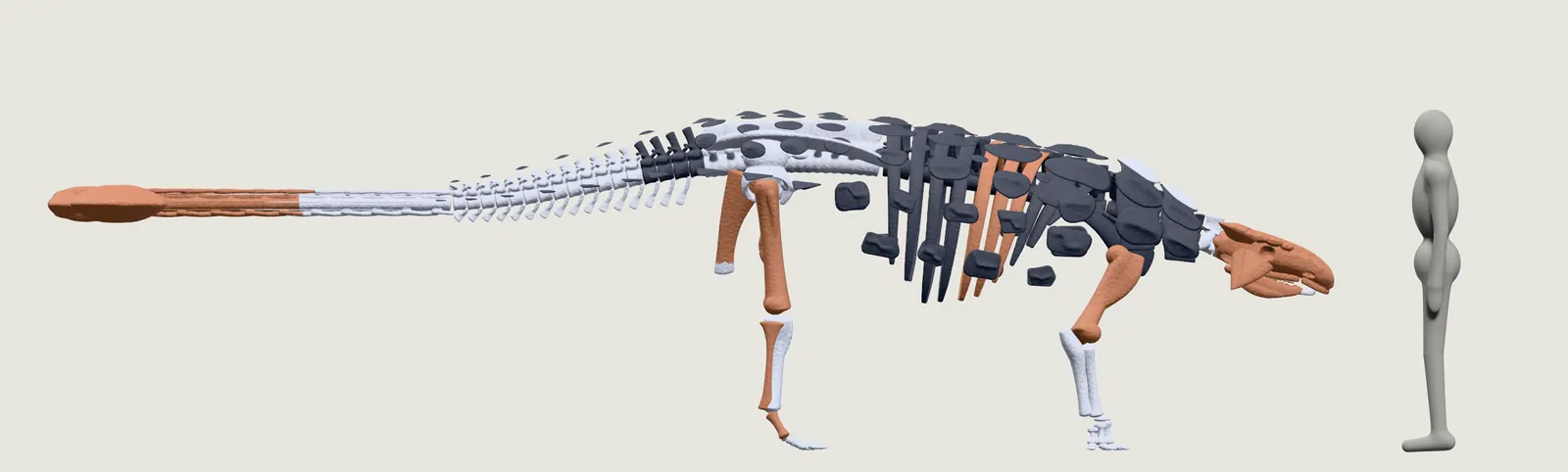
- Found with this animal (AMNH 5214)
- From other Ankylosaurus finds, scaled to its size
- From relatives or rebuilt
- Mirror copies of the other side are the right thigh bone, the top of the right ischium (a hip bone), the left calf bone and one foot bone. The plates have Ankylosaurus's own shapes, set in places guessed from relatives.
Ankylosaurus head and teeth
The head and the nose
The head was low and triangular, wider than long, with four short horns at its back corners. Its nostrils sat on the sides of the snout and faced down, hidden from the front, unlike in its relatives. Inside, the air probably took a looping path, a heat exchanger in models of its relatives, but what this odd nose was for is not known.
The beak, the teeth and the food
In front was a horny beak, then rows of very small, leaf-shaped teeth, 34 to 36 in each upper jaw. In the skull ours is built on, the biggest is about 9 mm high, tiny for an animal of nearly 5 tonnes. It probably ate low plants, perhaps ferns and shrubs, but its exact food is not known.
Ankylosaurus vs T. rex
Ankylosaurus and T. rex lived at the same time in the same land, and their bones lie in the same rocks. Yet no known fossil shows the two meeting: no T. rex bite on an Ankylosaurus bone, no club wound on a T. rex. Who would win has no answer in the rocks.
What can be said: a large T. rex was about twice as heavy, about 8 to 9 tonnes against about 4.8 for the animal ours is built on. Ankylosaurus wore plates and could swing a club, though its relatives seem to have used theirs mostly on each other.
In our picture the highest point of our Ankylosaurus stays below our T. rex's knee.
- Our T. rex, after SUE, about 11.4 m
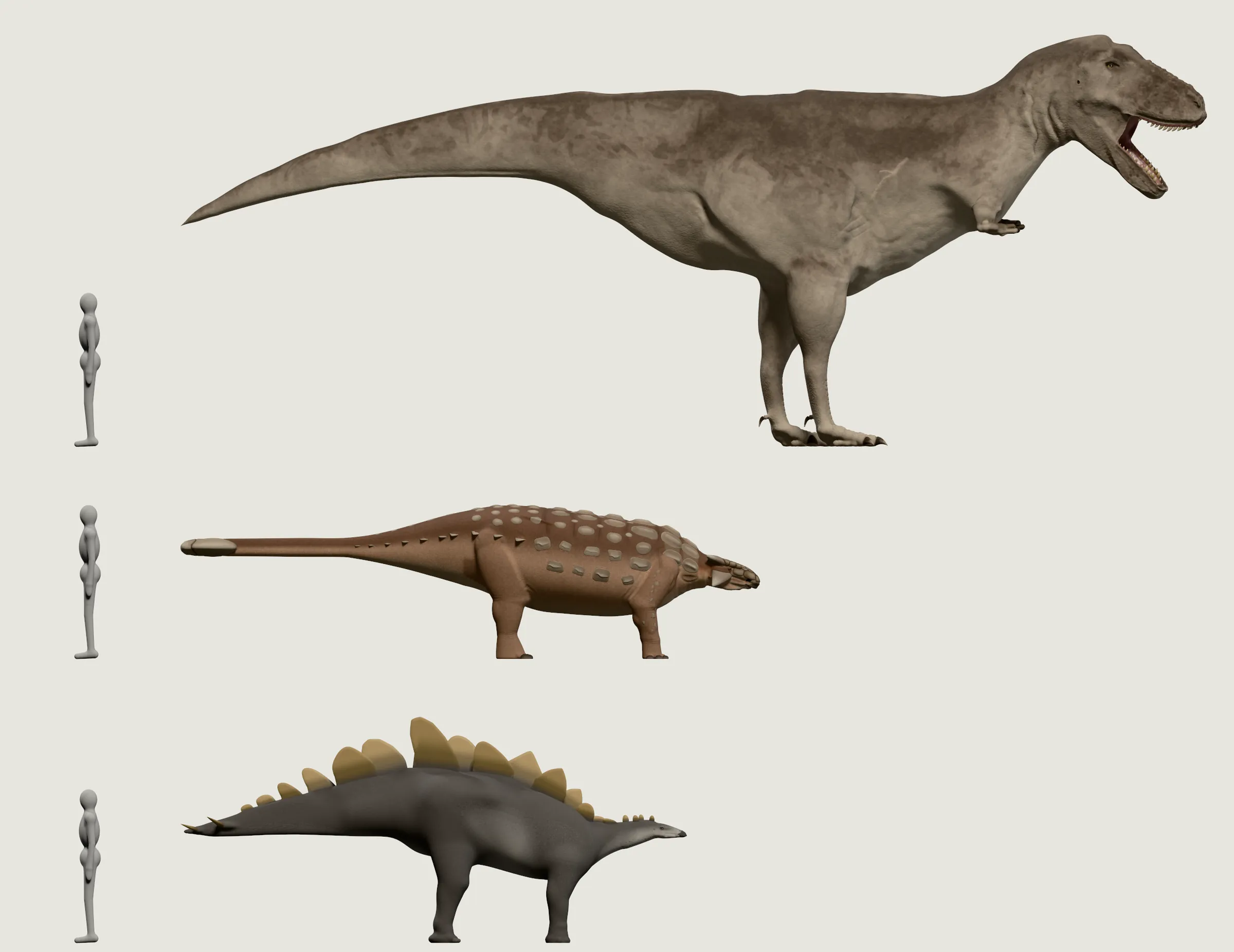
- Our Ankylosaurus, 6.4 m
- Our Stegosaurus, after Sophie, about 5.6 m
- The person, 1.70 m
Stegosaurus and Ankylosaurus
They never met: about 80 million years lie between them. Stegosaurus lived in the Late Jurassic, about 150 million years ago, so Ankylosaurus lived closer in time to us than to Stegosaurus. People pair them as armoured plant eaters, related within one larger family tree.
When and where Ankylosaurus lived
Ankylosaurus lived in western North America, in what is now Alberta, Saskatchewan, Montana and Wyoming, from about 68 million years ago until near the end of the Cretaceous, about 66 million years ago. The collapse that ended it is thought to have been set off by an impact in the Yucatán.
Numbers you may have read
For each number: where it came from, and what it means.
- 8 m long
- The upper end for the biggest animals, judged from the biggest skull. The smaller animal ours is built on was most likely near 6 m.
- 10 m long
- Calculated from the biggest skull with the same method as the smaller animal's length, from relatives' tails, and called probably too long by its own authors.
- 8 tonnes
- A rough scaling for the biggest skull, which has no body, and its own authors ask for caution.
- A bone-breaking club that killed T. rex
- No known T. rex bone carries a club wound, and the one Ankylosaurus knob known sits just under the size that could break bone in a model of relatives' clubs.
- Shoulder spikes
- Old pictures borrowed them from another family of armoured dinosaurs.
- A spiked ball at the tail's end
- The only knob found is a low, flat disc, 19 cm high, with no spikes.
- The biggest armoured dinosaur
- The 2017 study calls Ankylosaurus the biggest known ankylosaurid, and possibly the biggest ankylosaur of all.
- A living tank
- An image, not a finding. Ankylosaurus's plates sat apart in flexible skin, and in its relatives the belly had no big plates.
More questions
How heavy was Ankylosaurus?
About 4.8 tonnes for the animal ours is built on, worked out from its leg bones. The study's own spread runs from 3.6 to 6 tonnes.
What does the name Ankylosaurus mean?
Fused lizard, says the Natural History Museum in London, after bones that grew together. Barnum Brown, who also led the first find of T. rex, gave the full name, Ankylosaurus magniventris, in 1908.
How tall was Ankylosaurus?
No height measured on a real Ankylosaurus has been published. Ours, built up from its bones, is 1.70 m (5.6 ft) at the top of the back over the hips, its highest point.
In the museum
Museum of Ages is a digital museum, made by a nonprofit. Free entry, no account. In the animal wing this animal will stand among the others, from the giants of long ago to the last of their kind. The Leonardo da Vinci wing shows what a finished wing looks like.
-
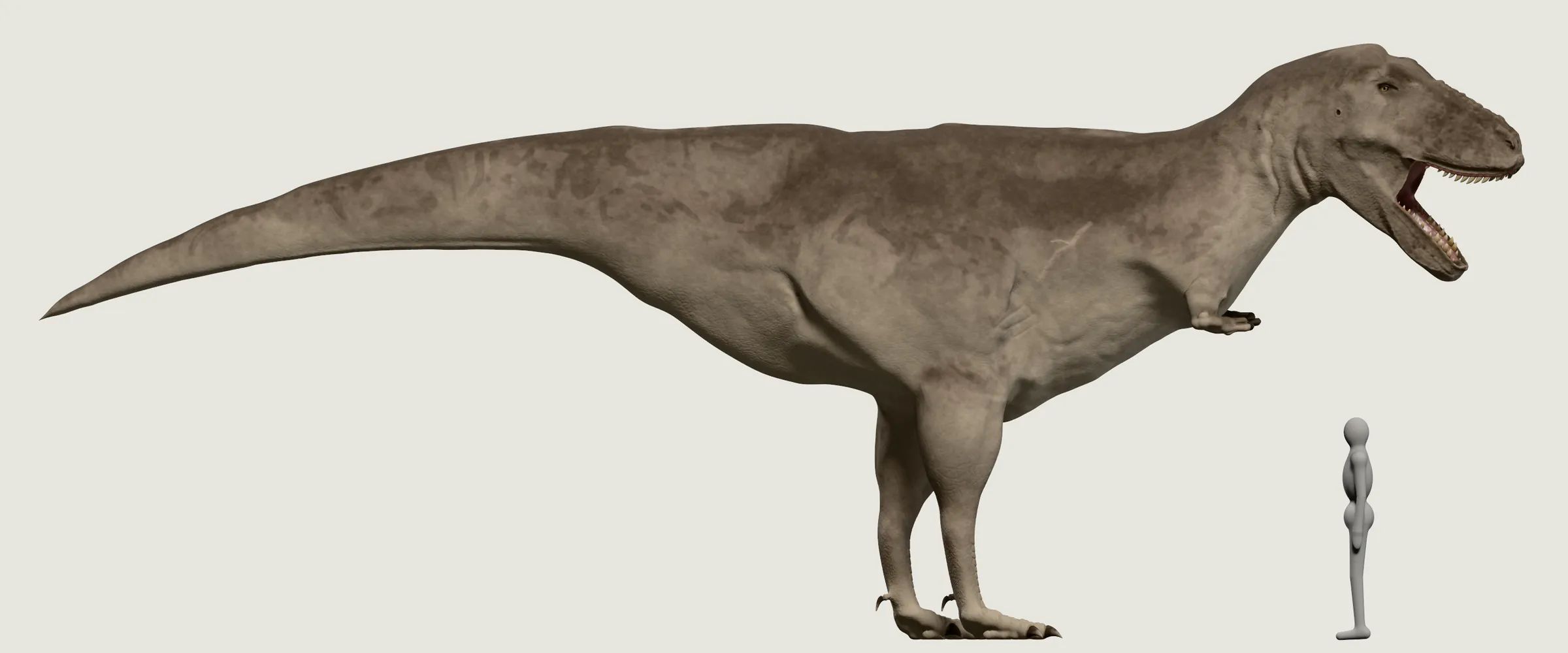
How big was T. rex?
A large adult T. rex was about 12 m long, about 4 m at the hips and roughly 8 to 9 tonnes. Our T. rex is built to SUE's measurements and stands beside a person to one scale, with a list of what was found of SUE.
-
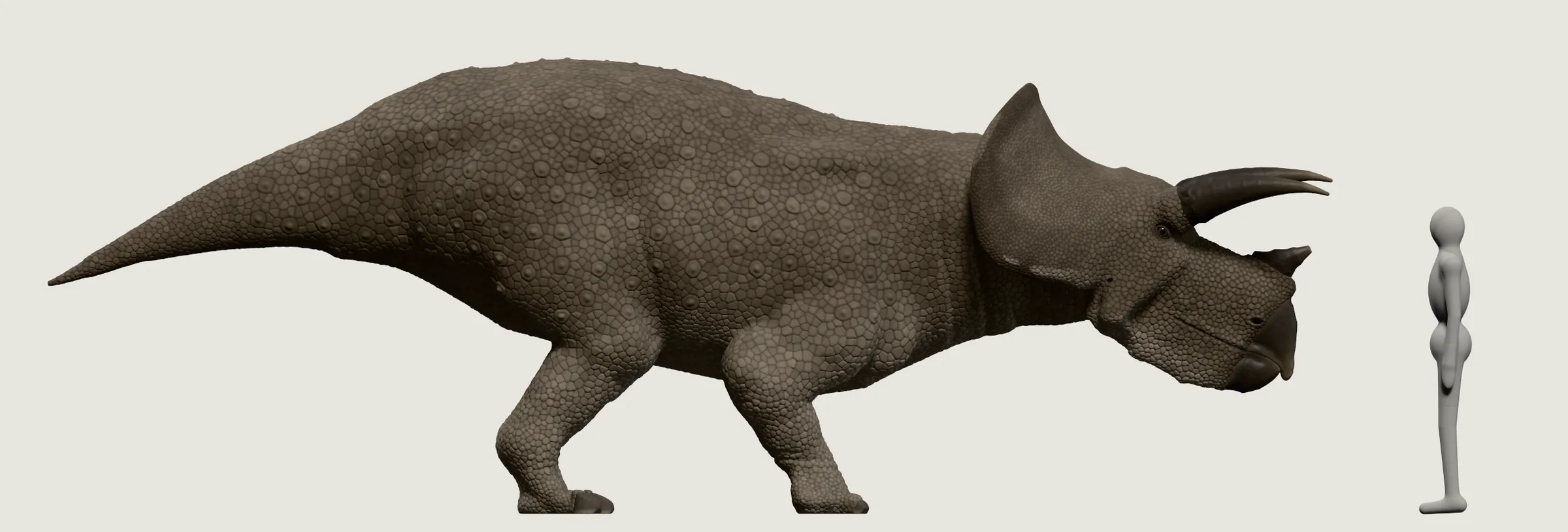
How big was Triceratops?
A big adult Triceratops was about 7 to 8 m long, with a skull about 2 m. Our Triceratops is built after the Washington skeleton, a mount of about ten animals, and stands beside a person to one scale, with Torosaurus and what the bones say about T. rex.
-
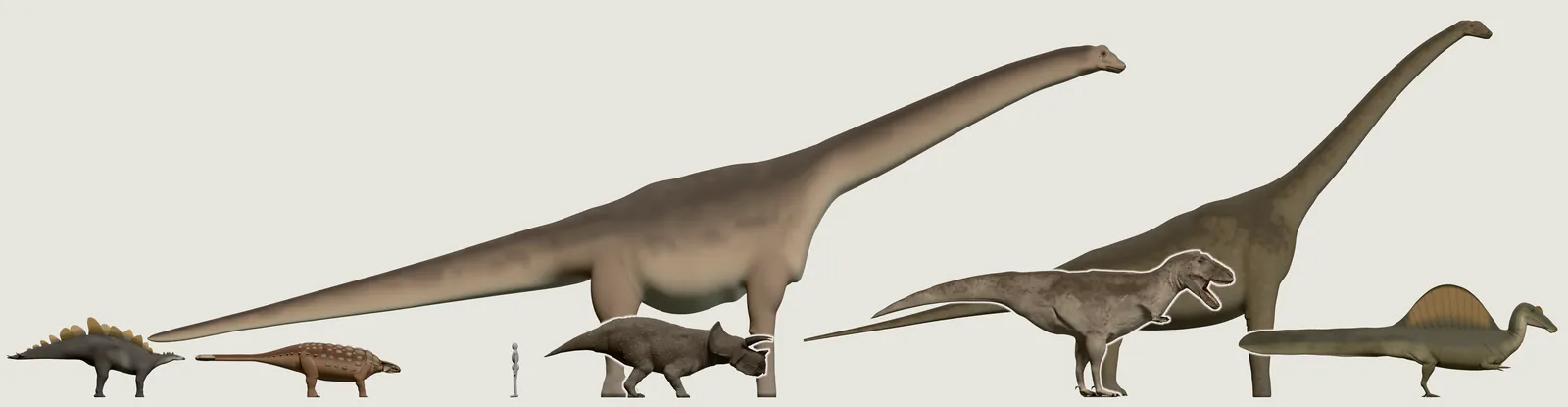
What was the biggest dinosaur?
Seven of ours beside a person, to one scale: the heaviest most likely a titanosaur from Patagonia, the tallest probably Sauroposeidon, and why the longest is still open.
Sources
The numbers come from these studies and from the museums that keep the bones. The museum is independent of all of them.
- Arbour and Mallon, 2017, FACETS, on its size, weight, club, skull and armour.
- Arbour, 2009, PLOS ONE, on the swing and force of tail clubs.
- Arbour, Zanno and Evans, 2022, Biology Letters, on the healed plates of Zuul.
- Bourke, Porter and Witmer, 2018, PLOS ONE, the study's summary, on the looping noses of relatives.
- Horner, Goodwin and Myhrvold, 2011, PLOS ONE, the count of Hell Creek dinosaurs.
- Barnosky and others, 2011, Nature, on the end of the Cretaceous.
- American Museum of Natural History, New York: its expedition reports of 1910 and 1911.
- Natural History Museum, London: its Ankylosaurus and Stegosaurus pages.
- The Canadian Encyclopedia: its article on Ankylosaurus, 2025.
- T. rex and Stegosaurus: the numbers and sources of our T. rex and biggest dinosaurs pages.
If a number or a museum is wrong, tell us and we will correct it. To the legal notice
Use our pictures
The four pictures of the Ankylosaurus on this page, the side view, the club, the skeleton and the row with our T. rex and our Stegosaurus, are our own work under CC BY-SA 4.0, credit: Museum of Ages, Ankylosaurus armour after Arbour and Mallon 2017 (CC BY 4.0). They show a reconstruction, built in code and rendered in our own engine, not photographs. The pictures of the other pages listed here give their credits on those pages.