Leonardo da Vinci's flying machines
Leonardo da Vinci drew flapping-wing machines and an aerial screw in Milan in the late 1480s (Manuscript B, Institut de France), and a parachute and a glider on sheets with no firm date, now in Milan and Madrid. No known document shows that he or anyone else flew one in his lifetime, but in 2000 a man jumped with a version of his parachute, and in 2002 a pilot flew a glider after his drawings.
The drawings and their notes are in his own hand. The Science Museum in London dates his sketches of flapping machines to between 1486 and 1490. The parachute is in the Codex Atlanticus at the Ambrosiana in Milan, the glider in Codex Madrid I at the national library in Madrid.
Free entry, no account.
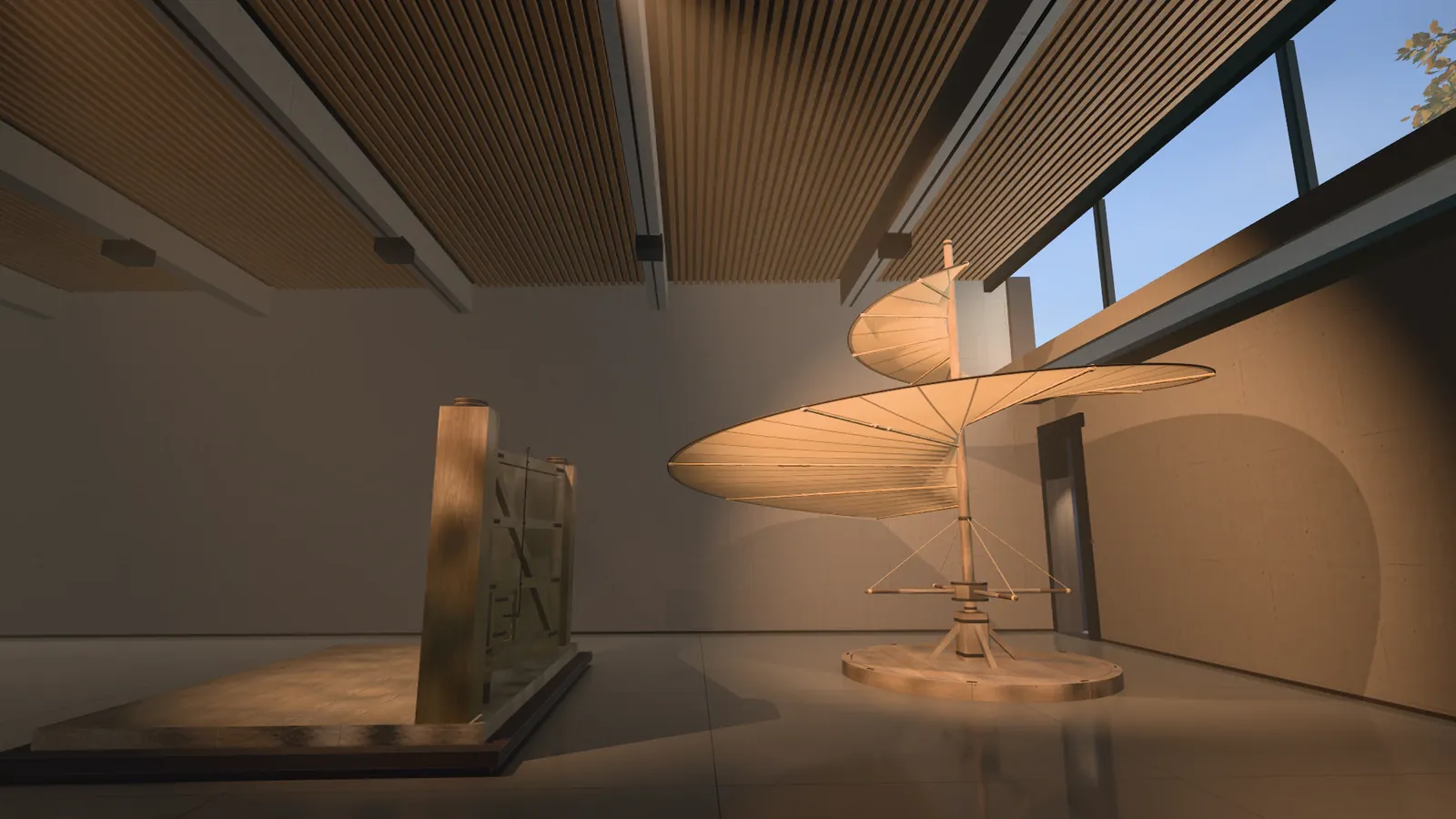
The door opens the Leonardo wing at the aerial screw, in the mechanism hall.
What flying machines did Leonardo da Vinci design?
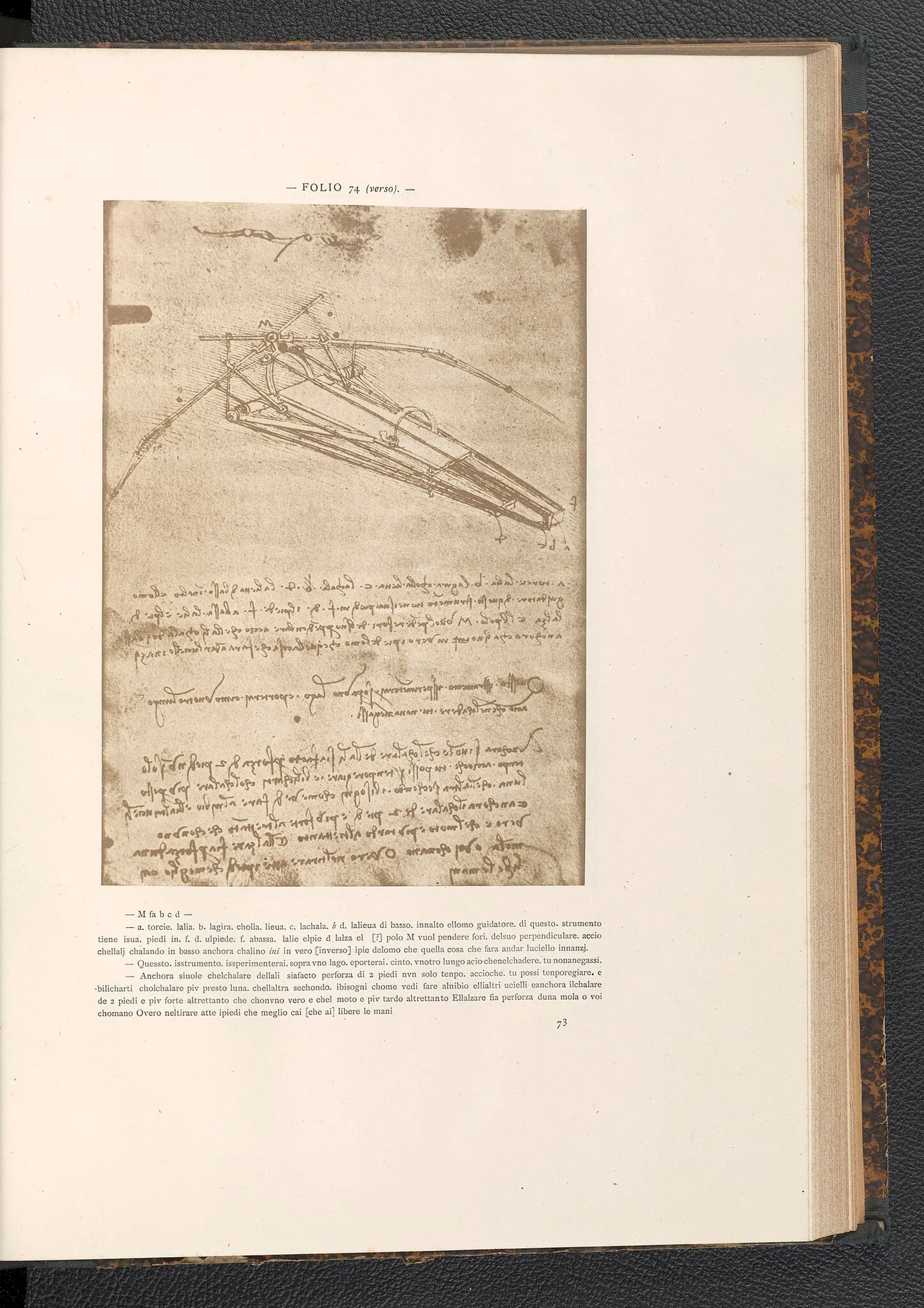
Mostly ornithopters, machines meant to beat their wings with the pilot's own strength. He drew them in Milan in the late 1480s, in Manuscript B, which Ravaisson-Mollien printed in facsimile in 1883.
On folio 74 verso the pilot lies flat, pulls the wings down with one foot and lifts them with the other. He steadies himself by beating one wing faster, as the kite does. On folio 80 recto the pilot stands and pushes with his head and both hands, each with a force about equal to his own weight. The wings of that machine open 40 braccia, about 23 metres.
The Ambrosiana, which holds the Codex Atlanticus, describes several of its sheets with mechanical wings. Some are worked by a crank winch, some by hand, and some by arms and legs together. The Ambrosiana describes one more sheet with a small flying machine set on a ladder. Museo Galileo places the earliest of his drawings of flying machines about 1480, while he still lived in Florence.
The machines he drew for water, work and war are on our page of the machines on his sheets, which also says which of them anyone ever built.

Did Leonardo da Vinci invent the helicopter?
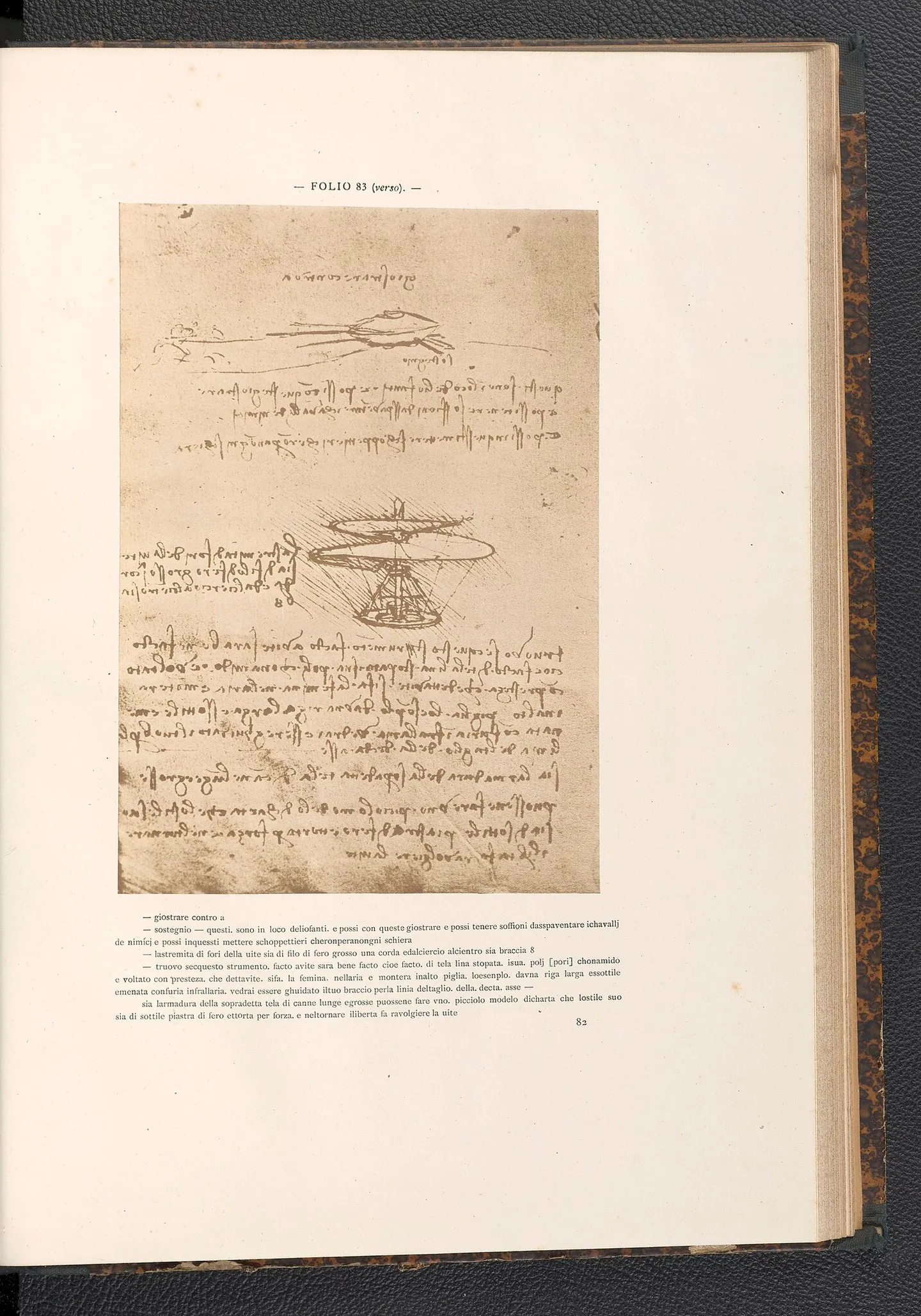
He drew the idea of lift from a turning surface, not a working helicopter. His aerial screw, on Manuscript B, folio 83 verso, is a spiral of linen on a frame of cane. His note says the screw would rise if it was well built and turned fast, with its linen made airtight by starch. It would then grip the air the way a screw grips its nut.
His note names one measure: eight braccia from the rim to the centre, about 4.7 metres, so the screw would be about nine metres across. A museum in Milan reads the eight braccia as the width of the screw's base, about five metres.
The sheet names no drive for the large screw, only a twisted iron strip for a small paper model. A model made in Milan in 1952 and 1953 has four men to turn it, an addition by its makers, not by Leonardo. The push bars on our own model are our choice. That museum in Milan also says he knew a full-size screw could not work without a suitable motor.
A turning screw pushes the frame it hangs from the other way, so the frame would spin against it, and nothing on the sheet stops that. Student engineers at the University of Maryland in 2020 and at San Francisco State University in 2023 name the problem in their own designs.

Did Leonardo da Vinci's parachute work?
Partly. In 2000 Adrian Nicholas jumped with a full-size version and came down under it. He cut it away before landing and came down the last part under a modern parachute. A news report of 2008 says he did so because he feared its wooden frame would hurt him on landing.
The Science Museum in London says the replica worked well and gave a smoother ride down than an ordinary parachute. The University of Tübingen's museum calls the jump a successful test. He did not land with it, though.
The same news report says that in April 2008 a Swiss man, Olivier Vietti-Teppa, jumped from a helicopter at about 600 metres over the military airfield of Payerne and landed under the canopy. It was made of modern cloth and mosquito netting, with no wooden frame.
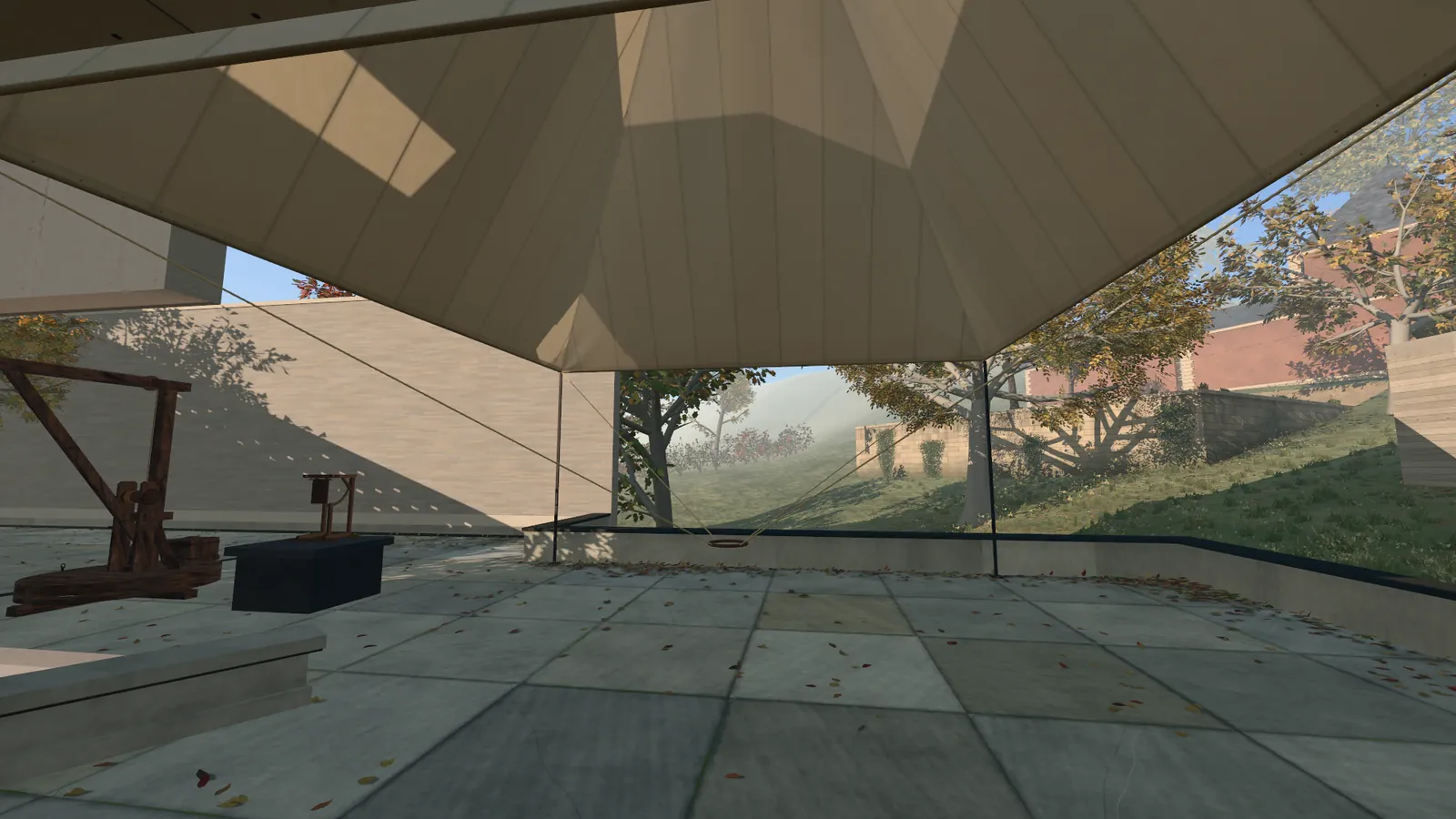
The drawing is in the Codex Atlanticus, on folio 1058 verso, in the Veneranda Biblioteca Ambrosiana in Milan. At the top of the sheet he drew a parachute shaped as a square pyramid, with a note on its size: twelve braccia wide and twelve high, about seven metres each way.
Did Leonardo da Vinci design a glider?
Yes. The national library in Madrid, which holds Codex Madrid I, describes a glider on its folio 64 recto, meant to ride on air currents and the wind and steered by the pilot shifting his weight. That it would fly is the catalogue's view, not the result of a test.
In October 2002 the pilot Judy Leden flew a glider built after his drawings from materials he could have had: a linen sail on a frame of poplar and bamboo, tied with leather and hemp, as the FAI records. We could not check which of his sheets it followed or what was changed.
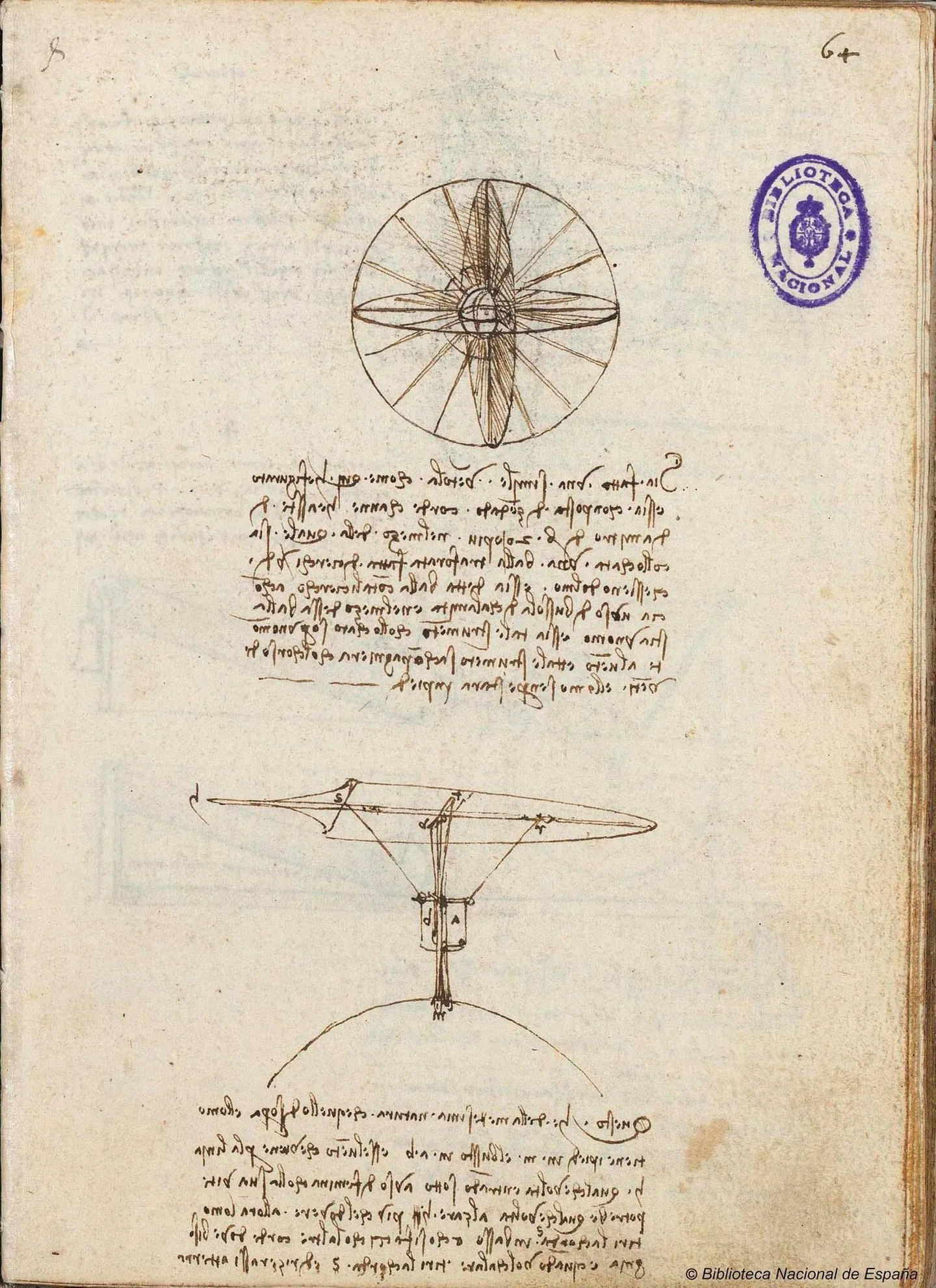
Could his flying machines have flown?
Not on a person's muscles. According to Museo Galileo, his notes show that he came to see a man's muscles were too weak to fly. Two of his ideas have carried a person in our time: the parachute and the glider. None of the modern flights we found used a machine exactly as he drew it.
What did he learn from birds?
That birds lean on the air more than on their wing beat, riding currents and wind and keeping their balance with wings and tail. Over time he looked less to muscle and more to the wind, as Museo Galileo reads his notes. He kept drawing wings all the same.
The Codex on the Flight of Birds is a notebook of eighteen leaves, about 21 by 15 centimetres. He wrote it in 1505 and 1506, on the flight of birds and, as its Italian title says, other matters. The kite, a bird of prey, is the bird it shows most.
Did Leonardo da Vinci try to fly?
No known document records a flight of his. One writer, Girolamo Cardano, reports a failed try: in 1550, 31 years after Leonardo's death, he wrote in Latin that Vinci had tried to fly, and in vain, "tentavit et frustra". He names no place, no date and no witness.
His notes plan tests but report none. He meant to test the prone machine over a lake, with a long wineskin round the waist in case of a fall. No record of the test being made is known.
In a note linked to the Codex on the Flight of Birds he wrote that the great bird would take its first flight from the back of its great swan. It is a promise, not a report. Museo Galileo takes the swan to be Monte Ceceri above Fiesole, a hill named after the swan.
A legend says that one of his followers, Tommaso Masini, called Zoroastro, tried a flight from Monte Ceceri and fell. We found it in no document of the time, and Museo Galileo calls it a legend.
Where are the drawings today?
In four libraries. Manuscript B is in the Bibliothèque de l'Institut de France in Paris, the Codex Atlanticus in the Veneranda Biblioteca Ambrosiana in Milan, Codex Madrid I in the Biblioteca Nacional de España in Madrid, and the Codex on the Flight of Birds in the Biblioteca Reale in Turin.
From 2022 to 2025 the Biblioteca Reale in Turin showed it each spring for about a week, around Easter, according to the Italian culture ministry.
How do we know?
From his own sheets, printed in 1883, and from the libraries and museums that hold or study them.
Ravaisson-Mollien printed Manuscript B in facsimile in 1883, and Richter published many of his notes in English the same year.
Some questions stay open. We do not know the year of the parachute's sheet or of the glider's, or which braccio he meant on a sheet drawn in Milan. Nor do we know which sheet the glider of 2002 followed, or whether Cardano's report is true.
The machines on his sheets, and which of them anyone ever built
The numbers
The table shows, for each figure on the page, what it rests on, how sure it is and where it comes from.
| Figure | Basis | Known or guessed | Source |
|---|---|---|---|
| Late 1480s, Manuscript B | The Science Museum in London dates his flapping machines to between 1486 and 1490. | Guessed | Science Museum 2019 |
| About 1480, his earliest drawing of a flying machine | Museo Galileo gives this year but names no sheet. | Guessed | Museo Galileo |
| 1505 and 1506, the Codex on the Flight of Birds | The ministry gives both years. The library's own list gives 1505, the first of them. | Known | Ministero della cultura |
| 18 leaves, about 21 by 15 cm | Three sources agree on the leaves. The size comes from one list, which gives it for a facsimile copy of the codex. | Known (leaves), Guessed (size) | Musei Reali |
| The braccio, about 58 cm | Our wing uses the Florentine braccio. Which one he meant is not known. | Guessed | our choice |
| Aerial screw, 8 braccia from the rim to the centre, about 4.7 m, about 9 m across | His note gives the braccia. | Known in braccia, guessed in metres, as the braccio he meant is not known | Ravaisson-Mollien 1883 |
| The same 8 braccia as the base, about 5 m | A museum in Milan reads the braccia this way. | Guessed | Museo Nazionale Scienza e Tecnologia |
| Parachute, 12 braccia wide and 12 high, about 7 m | His note gives the braccia. | Known in braccia, guessed in metres, as the braccio he meant is not known | Museo Nazionale Scienza e Tecnologia |
| Wings of the standing machine, 40 braccia, about 23 m | His note gives the braccia. | Known in braccia, guessed in metres, as the braccio he meant is not known | Ravaisson-Mollien 1883 |
| 2008 jump, about 600 m | One news report gives it in feet, and we converted it. | Guessed | Fox News 2008 |
Things often read
"Leonardo invented the first helicopter."
"The first helicopter" is a later label. None of the sources we read says the aerial screw ever flew.
"The jump of 2000 showed that his parachute works."
He let it go before landing and finished under a modern parachute.
"His parachute had faces with three equal sides."
His note gives twelve braccia wide and twelve high, so it is a square pyramid as high as it is wide. Faces with three equal sides would make it lower.
"His aerial screw was about five metres across."
Both figures are readings of one note. It measures eight braccia from the rim to the centre, a radius, so about nine metres across. A museum in Milan reads the same braccia as the width of the base, about five metres. Ours follows the note's words.
"He flew a machine from Monte Ceceri."
It is a legend about one of his followers, not about him, and Museo Galileo calls it a legend.
Sources
Facts checked against the sources on .
The facts on this page come from these sources.
Where the sheets are kept
- Bibliothèque de l'Institut de France Paris: Manuscript B (Ms 2173), folios 74 recto to 88 verso.
- Veneranda Biblioteca Ambrosiana Milan: Codex Atlanticus, folio 1058 verso and the sheets with mechanical wings. The Codex Atlanticus, the Ambrosiana's page
- Biblioteca Nacional de España Madrid: Codex Madrid I (Mss/8937), folio 64 recto.
- Biblioteca Reale Turin: the Codex on the Flight of Birds.
- Ch. Ravaisson-Mollien, Les manuscrits de Léonard de Vinci, volume 2, Paris 1883, Manuscript B in facsimile (in French, Internet Archive)
- J. P. Richter, The Literary Works of Leonardo da Vinci, 1883, no. 1428 (Project Gutenberg)
- G. Cardano, De subtilitate, Nuremberg 1550 (in Latin, Internet Archive)
- Veneranda Biblioteca Ambrosiana, Codice Atlantico (in Italian)
- Biblioteca Nacional de España, El imaginario de Leonardo, exhibition catalogue, 2012 (in Spanish, PDF)
- Musei Reali Torino, list of works, 2024 (in Italian, PDF)
- Ministero della cultura, A tu per tu con Leonardo in Biblioteca Reale, 14 April 2022, with the showings up to 2025 (in Italian)
- Museo Galileo, Studies on flight
- Museo Galileo, La Toscana di Leonardo, Municipality of Fiesole
- Museo Nazionale Scienza e Tecnologia, Milan, Vite aerea (in Italian)
- Museo Nazionale Scienza e Tecnologia, Milan, Paracadute (in Italian)
- Musei Capitolini, Leonardo e il volo, press release, 2017 (in Italian, PDF)
- B. Russell, Remembering Leonardo da Vinci, Science Museum blog, 1 May 2019
- Museum der Universität Tübingen, Fallschirm, eMuseum (in German)
- University of Maryland, Samara, a design proposal for the Vertical Flight Society, 2020 (PDF)
- San Francisco State University, Da Vinci Helicopter Swashplate, 2023
- FAI, Judy Leden, multiple champion and record holder
- University of Derby, Judy Leden's commendation
- Fox News, Swiss man safely uses Leonardo da Vinci parachute, 29 April 2008
If a date, a figure or a sentence is wrong, a message is enough, and we will correct it. To the legal notice
See the aerial screw in the museum
Our aerial screw stands in the mechanism hall of the Leonardo wing, built in code after his sheet and labelled as a reconstruction. This door opens the wing there.
Free entry, no account.