Leonardo da Vinci's Last Supper
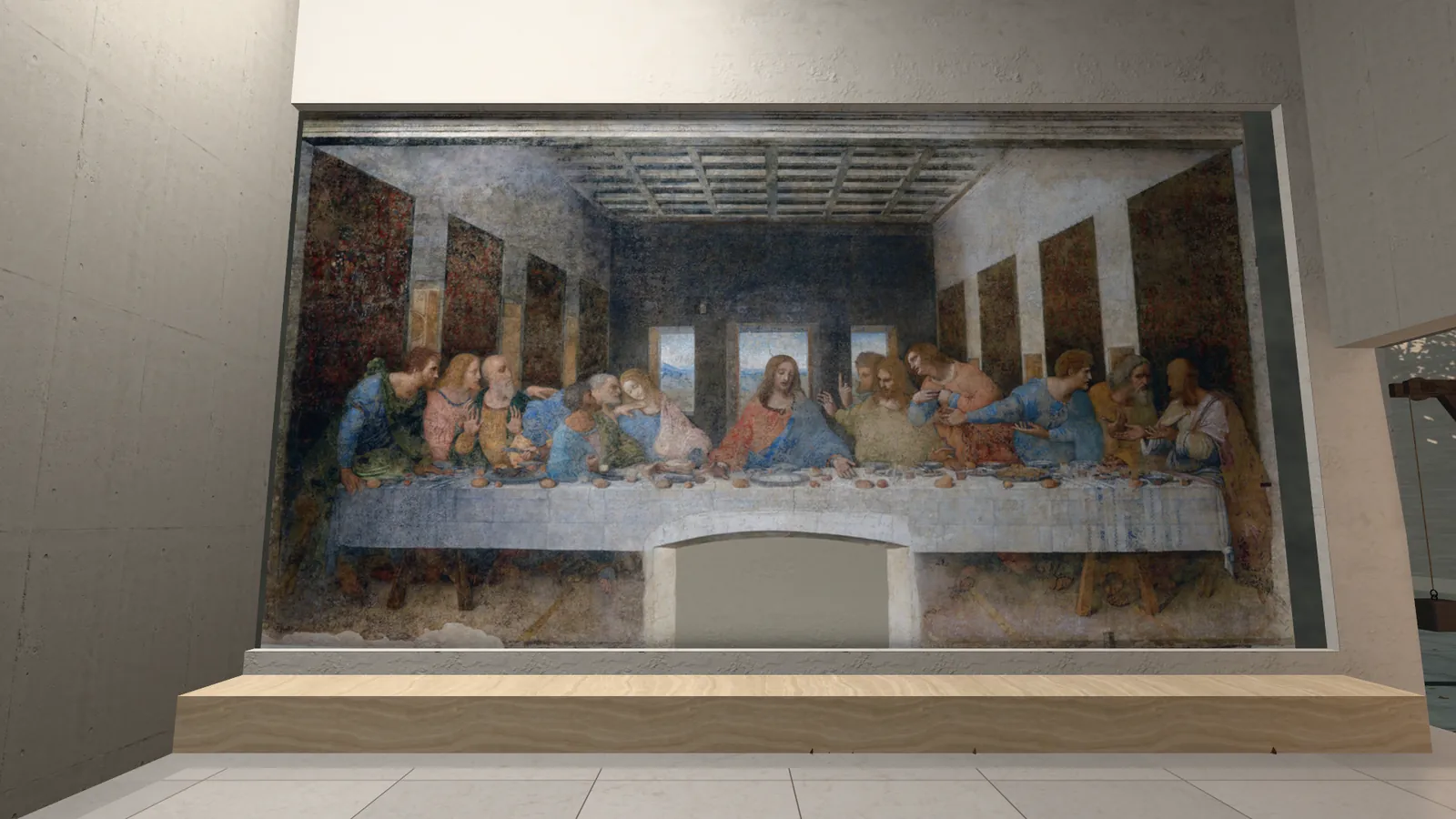
The Last Supper is a wall painting. Leonardo da Vinci painted it in Milan, in the refectory of Santa Maria delle Grazie, the dining hall of a Dominican convent. He painted it for Ludovico Sforza, Duke of Milan, in about 1494 to 1498, and it is still on the wall he painted it on: the museum gives 4.6 by 8.8 metres, height by width. Look under the table: Christ has no feet. In the seventeenth century the friars wanted a bigger doorway into their kitchens. The one they widened sits in the middle of that wall, right where his feet had been.
Free entry, no account.
The door opens the Leonardo wing at the wall in the court.
How he painted it, and why it began to fail
A wall painting of his time was usually a fresco. The painter works fast on wet plaster, and as the plaster dries it takes the colour in. Leonardo did not want to work fast. The museum explains that he wanted to go slowly and change things as he went. So he let the plaster dry, laid a white ground on it and painted with tempera, treating the wall like one of his wooden panels. A lab study of 2023 points to oil in the mix too.
That is why it began to fail. Nothing bound the colour to the wall. It lay on top like a skin, and the room was damp. Within about twenty years it was coming off: in 1517 a visitor already saw the decay. In 1568 Vasari wrote that little could be made out beyond “a glowing stain”, as the museum's site quotes him.
Five centuries on a wall
The damage came in waves. In the seventeenth century the friars enlarged the door under the table (a catalogue dates it to 1652), and Christ's feet were lost. In the 1720s a restorer took the picture for an oil painting, a national catalogue says. He washed the wall down with caustic soda, gave it a coat of oil varnish and painted large parts of it anew. In the 1770s it was painted over once more. In 1821 another restorer tried to peel sections off the wall, and failed. Under Napoleon the room was used by troops, as a stable by one account.
Then the war. In August 1943 a bomb exploded in the cloister next door. The refectory lost its roof vault and the wall at its east end. The painted wall held. Since 1940 it had stood behind a steel frame and a thick wall of sandbags, and that shield is what saved it. The room was rebuilt from 1945.
The long restoration
Restorers have been at the wall since the early 1700s, about nine times by the museum's count. For most of that time restoring meant repainting what was missing. In the early 1900s Luigi Cavenaghi restored it, and in the 1950s Mauro Pellicioli secured the flaking surface without taking the old overpaint off.
The last restoration was different. Pinin Brambilla Barcilon began in the late 1970s and finished in 1999, more than twenty years later. Behind her stood the Milan Soprintendenza and the central restoration institute in Rome, as the press reported. Her team took off the overpaint of the earlier centuries. Under magnification they cleaned what was left of Leonardo's paint, flake by flake, and toned the gaps with watercolour, which water will lift off again. Earlier restorers, she reported, had shifted eyes, shut mouths and put beards on faces that had none.
What came back is thin. How much of the paint is still Leonardo's own? The experts' estimates lie between a fifth and a half. No single figure is agreed.
Seeing it in Milan today
The painting is still in its room. With the church and the convent, it has been a UNESCO World Heritage Site since 1980. The air in the refectory is filtered and its climate is controlled. So you enter through a chain of small rooms whose doors open one after the other, and the visits are short, timed and in small groups. Booking is required.
On the wall opposite is a Crucifixion by Giovanni Donato Montorfano. He signed it, dated it 1495 and painted it in fresco. It has kept its colour far better than Leonardo's wall. Kneeling figures of the duke's family were painted onto it later, probably by Leonardo, the museum says, and of them almost nothing is left. For a visit, the museum's own site: cenacolovinciano.org.
What our copy shows, and what it cannot
The museum's Leonardo wing has a copy of the Last Supper on a wall of its court. It is a reproduction, and it has the original's height and width, 4.6 by 8.8 metres. It shows you what a book cannot: the whole composition at its real size, with you standing in front of it, Christ in the middle and the apostles in four groups of three.
What a flat copy cannot show is the wall itself: how the flakes of paint stand up from the plaster, and how fragile it all is. And it cannot show the room's light. In Milan the painted light comes in from the left, the same side as the real windows of the hall. Take the painting off that wall and the pairing is gone.
How big it is beside the Mona Lisa and the other works: the sizes page.

Sources
The page relies on these, all read on 12 October 2026:
- Museo del Cenacolo Vinciano, the work
- Museo del Cenacolo Vinciano, technique, conservation and restorations
- Museo del Cenacolo Vinciano, the history
- Museo del Cenacolo Vinciano, the Crucifixion by Montorfano
- Museo del Cenacolo Vinciano, the verbal description of the painting (PDF)
- Museo del Cenacolo Vinciano, the museum sheet of 2023 (PDF)
- Ministero della Cultura, the venue
- Regione Lombardia, catalogue record of the painting
- Regione Lombardia, catalogue record of the refectory
- ICCD, national catalogue record (1975)
- The Art Newspaper, 1 November 1998, on the restoration
- The Art Newspaper, 30 April 1999, on how much is Leonardo's
- University of Amsterdam, 2023, on oil in the paint
If a date, a name or a sentence is wrong, tell us and we will correct it. To the legal notice
See the Last Supper in the wing
This door goes straight to the wall in the court. The full walk starts in the picture room, with the Mona Lisa.
Free entry, no account.